
DOMEIXA® Insights • Marketing Attribution, Growth & Domain Strategy
Unmasking Dark Traffic: How Confusing Domains Distort Marketing Attribution
Why customers who cannot remember your domain often search for your brand, click a paid advertisement or disappear completely—and how this hidden journey corrupts channel reporting, inflates branded-search dependence and obscures the true source of demand.
Core Principle
Analytics records the final observable path. It does not automatically reveal the marketing event that created the customer’s original intent.
Quick answer: can a confusing domain distort marketing attribution?
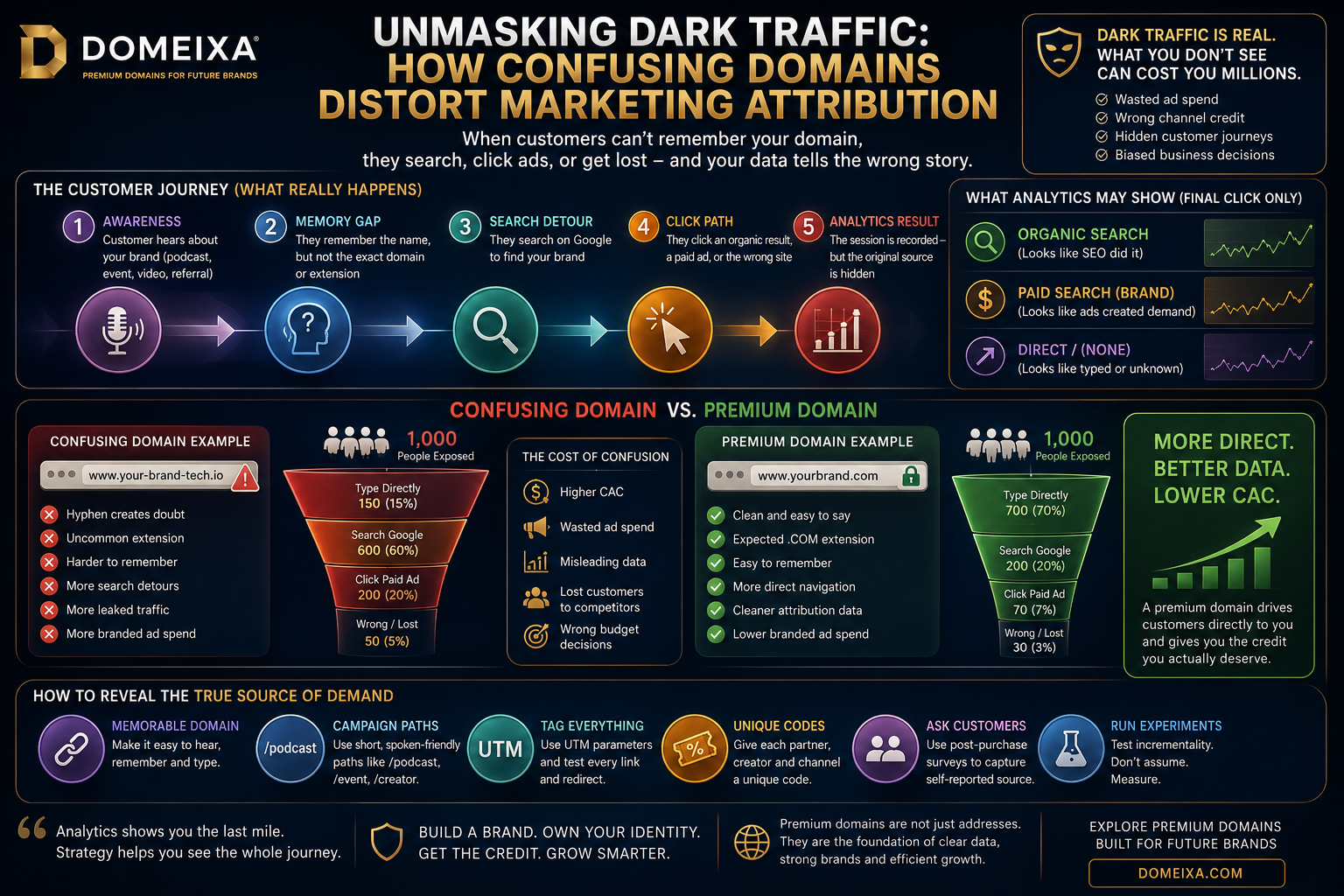
Yes—but the distortion is indirect. When customers hear about a company through a podcast, event, recommendation or video but cannot confidently reconstruct its domain, they often search for the brand instead of navigating directly. Analytics may then record the session as Organic Search or Paid Search even though the original demand was created by audio, public relations, an influencer, a conference or word of mouth. A memorable premium domain can reduce this search detour, but accurate attribution still requires disciplined campaign tagging, channel-specific landing paths, CRM data, post-purchase surveys and incrementality testing.
What is dark traffic?
Dark traffic is an analytical umbrella term for visits whose true marketing origin is hidden, incomplete or incorrectly represented in reporting. It is not an official Google Analytics channel name.
The term is often associated with private messaging, copied links, email applications and offline media, but the underlying problem is broader. Dark traffic appears whenever the measurable digital session does not preserve the interaction that originally created awareness or intent.
Hidden Origin
The original source—podcast, event, referral or conversation—is not transmitted to Analytics.
Search Detour
The customer searches for the remembered brand instead of entering the address directly.
Channel Reassignment
Organic or paid search receives session or conversion credit for demand created elsewhere.
Budget Distortion
The CMO may increase spending on the channel that captured the visit rather than the channel that generated intent.
The Attribution Gap
The channel that creates demand is not always the channel that captures the click
A prospect hears the company mentioned in a podcast, video, meeting or recommendation.
The prospect remembers the sound of the brand but not its exact spelling, hyphen or TLD.
The prospect asks Google to reconstruct the identity.
The prospect clicks an organic result or branded advertisement.
Search receives measurable credit while the original awareness source remains invisible.
How a vague domain creates a search detour
A customer who sees a clickable advertisement does not need to remember the address. A customer who hears a name must reconstruct the complete digital destination from sound and memory.
Every uncertain element increases the probability that the customer will use a search engine as an intermediary:
| Domain Friction | Customer Uncertainty | Likely Behaviour | Possible Analytics Outcome |
|---|---|---|---|
| Unexpected extension | Was it .COM, .AI, .IO, .TECH or another ending? | Search for the brand name | Organic Search or Paid Search |
| Hidden hyphen | Was punctuation part of the address? | Enter the non-hyphenated domain or search | Lost visit, referral to another domain or search traffic |
| Invented spelling | Which of several plausible spellings is correct? | Search phonetic variants | Organic Search, Paid Search or competitor exposure |
| Number ambiguity | Was it 4, four or for? | Search the remembered phrase | Search receives credit |
| Singular or plural ambiguity | Was the final “s” part of the brand? | Try several domains or use Google | Fragmented or missing traffic |
| Long compound name | Where do the words begin and end? | Search partial terms | Generic organic or paid search |
The same memorability problem is examined in The Radio Test: Premium Domains and Lower CAC. The Radio Test asks whether a listener can hear the complete identity once and type it correctly without visual assistance.
What GA4 actually means by Direct traffic
Google Analytics describes (direct) / (none) as traffic without a clear referral source. It can include users who typed the URL or used a bookmark, but it may also include visits where campaign information was missing, stripped or blocked.
Google specifically lists missing UTM parameters, redirects that remove parameters, offline documents and ad blockers among the reasons traffic may appear as direct.[1]
Potentially genuine Direct
- typed domain navigation,
- browser bookmarks,
- known returning customers,
- memorized brand addresses,
- manually entered URLs from offline media.
Potentially misclassified Direct
- untagged email links,
- private messaging applications,
- links copied from documents,
- UTM parameters removed by redirects,
- tracking blocked by browser or privacy tools.
A higher Direct share does not automatically prove stronger brand awareness. It can represent successful memorized navigation, but it can also reveal broken attribution. Direct traffic must be analysed alongside landing pages, new-versus-returning users, branded search, campaign tagging and self-reported acquisition data.
How GA4 classifies the customer’s final observable path
GA4 assigns traffic-source dimensions from the information available when the session or event is processed. Organic Search represents visits from unpaid search results. Paid Search represents traffic identified as paid-search activity. Direct represents sessions without a clear source.[2]
| Real Customer Journey | Recorded Session Source | What Analytics May Miss |
|---|---|---|
| Podcast → typed domain | Direct | Podcast name, episode, host and placement |
| Podcast → Google brand search → organic result | Organic Search | Podcast created the demand |
| Podcast → Google brand search → advertisement | Paid Search | Podcast created the demand and paid search captured it |
| Conference → QR code with UTMs | Tagged campaign source and medium | Offline influence beyond the scanned interaction |
| Private message → untagged copied link | Direct or Referral, depending on transmitted data | The person or conversation that generated the referral |
| Influencer video → memorable vanity path | Direct unless the path or redirect adds campaign identification | The influencer without a dedicated path, code or survey response |
Myth versus Reality
A premium domain automatically gives the company clean attribution data
False. A memorable domain can reduce search detours and typing errors, but it cannot tell Analytics whether the user first heard the name in a podcast, saw it on a billboard or received it from a colleague.
The premium domain improves the navigational layer. Campaign architecture, tagging, surveys, experiments and CRM integration improve the measurement layer. Strong marketing operations require both.
Why attribution reports may still credit an earlier search interaction
GA4 distinguishes several reporting scopes. The User acquisition report focuses on how new users were first acquired, while the Traffic acquisition report focuses on the source of individual sessions.[6]
Event-level conversion reporting can use the property’s attribution model. Google states that data-driven attribution distributes credit according to the contribution of available interactions, while paid-and-organic last click ignores Direct traffic and credits the last eligible non-direct interaction.[3]
This means that a customer may return by typing the domain directly, yet an earlier paid or organic interaction may continue receiving conversion credit in certain attribution reports. That is not necessarily an error. It is a consequence of the reporting scope and attribution model.
| GA4 View | Primary Question | Common Misinterpretation |
|---|---|---|
| First user source | How was this user originally acquired? | Treating it as the source of every later session |
| Session source | What initiated this particular session? | Assuming it created the user’s original demand |
| Event attribution | Which eligible interactions receive conversion credit? | Assuming the credited channel was the only causal influence |
| Self-reported attribution | What does the customer remember creating awareness? | Treating human memory as perfectly accurate |
The branded-search tax
A branded search campaign can be strategically useful. It may protect search-result visibility, control messaging, promote a specific offer and capture users who are already looking for the company.
The financial problem appears when the company repeatedly pays to recover customers who would have reached the website directly if the domain had been easier to remember and enter.
Brand-Recovery Cost
Incremental brand-search cost = Search-detour clicks × Incremental cost per click
This cost should not be interpreted as automatically wasted. Some users would search regardless of the domain, and branded advertisements can provide incremental value. The objective is to measure how much paid search is creating demand and how much is merely harvesting demand generated elsewhere.
If branded paid search were paused in a controlled experiment, how many conversions would disappear—and how many would move to organic or direct navigation instead?
Illustrative model: one podcast, three different attribution stories
The following example is hypothetical. It demonstrates how identical awareness can produce very different analytics depending on domain memorability and measurement design.
| Outcome from 1,000 Intended Visits | Confusing Domain | Memorable Domain Only | Memorable Domain + Measurement Architecture |
|---|---|---|---|
| Typed or memorized navigation | 150 | 600 | 600 through a memorable campaign path |
| Branded organic search | 400 | 220 | 180 |
| Branded paid search | 200 | 100 | 80 |
| Incorrect address or abandonment | 250 | 80 | 40 |
| Visits identifiable as podcast-generated | Close to zero without survey or campaign code | Close to zero if visitors enter only the home page | Substantial when a dedicated path, code or survey is used |
A memorable domain improves the probability of successful arrival. It does not identify the podcast by itself. The third scenario combines the navigational advantage of a strong domain with a memorable campaign path such as YOURBRAND.COM/PODCAST, a dedicated promotional code and a post-conversion attribution question.
The Correct Thesis
A premium domain reduces navigational ambiguity—not analytical uncertainty by itself
A clear .COM can make it easier for customers to move from memory to the correct website without a search-engine intermediary. This may reduce traffic leakage, accidental competitor exposure and dependence on branded paid search.
Attribution becomes materially stronger only when the company also preserves campaign identity through URLs, redirects, codes, CRM fields, surveys and experimental measurement.
Build a campaign-specific domain architecture
Google recommends adding UTM parameters to campaign destination URLs so that campaign source, medium and campaign name can be recorded in Analytics. The resulting values are available in acquisition reporting.[4]
Spoken and offline campaigns create a special challenge because customers cannot remember long query strings. The solution is a short, human-readable path that redirects to a tagged destination or is recorded as a campaign-specific landing page.
| Channel | Customer-Facing Address | Measurement Method |
|---|---|---|
| Podcast | YOURBRAND.COM/PODCAST | Dedicated landing page, campaign redirect and host-specific code |
| Conference | YOURBRAND.COM/EVENT | QR code with UTMs and event-specific path |
| Influencer | YOURBRAND.COM/CREATOR | Creator-specific path, UTM redirect and promotional code |
| Print advertisement | YOURBRAND.COM/GUIDE | Memorable path and QR code |
| Partner referral | YOURBRAND.COM/PARTNER | Partner ID, referral code and CRM source field |
| Audio advertisement | YOURBRAND.COM/OFFER | Channel-specific page and memorable offer code |
Test every redirect to confirm that campaign parameters survive the complete path. Google identifies stripped parameters and redirect problems as potential causes of Direct traffic misclassification.
Use Google Ads auto-tagging correctly
Google Ads auto-tagging adds a Google Click Identifier to ad destination URLs. Analytics can use this information to connect visits with campaign, ad group, keyword and cost data. Google recommends auto-tagging for the most detailed Google Ads reporting.[5]
Auto-tagging helps identify paid-search clicks accurately. It does not reveal whether the customer searched for the brand because of a podcast, event or recommendation.
Auto-tagging can identify
- the Google Ads click,
- campaign and ad-group context,
- keyword and query dimensions,
- cost and post-click behaviour,
- eligible imported conversion activity.
Auto-tagging cannot identify
- the offline event that created awareness,
- the colleague who recommended the brand,
- the podcast episode remembered by the customer,
- the billboard viewed before the search,
- the reason the customer chose the brand result.
A complete dark-traffic measurement stack
No single report can recover every hidden customer journey. Growth teams should triangulate several evidence sources.
GA4 acquisition scopes
Compare First user, Session and event-attribution dimensions instead of relying on one channel report.
Campaign URLs and vanity paths
Give every measurable placement a consistent source, medium, campaign ID and human-readable entry path.
Post-purchase surveys
Ask customers where they first heard about the company and preserve both the selected category and free-text answer.
CRM lead-source history
Keep original, latest and self-reported sources as separate fields rather than overwriting one value.
Promotional and referral codes
Use unique codes where links cannot reliably preserve identity.
Incrementality experiments
Use holdouts, geographic tests or campaign pauses to estimate what would have happened without the channel.
Branded-search monitoring
Track changes in branded organic queries, brand-ad clicks and direct navigation after major offline or awareness campaigns.
Measurement Principle
Observed attribution and causal attribution are not the same
Observed attribution describes the trackable interaction that appears in the platform. Causal attribution asks whether the customer would have converted without the channel.
A branded-search advertisement may receive an observable click and conversion while contributing little incremental demand. Conversely, a podcast may create substantial demand while receiving almost no click-based credit.
The CMO’s domain-attribution dashboard
| Metric | What It Can Reveal | Warning Signal |
|---|---|---|
| Direct sessions by landing page | Home-page recall versus campaign-path use | Large Direct volume landing on deep URLs that were probably shared |
| Branded organic sessions | Search demand for the company name | Sharp growth after offline campaigns with no credited source |
| Branded paid-search cost | Cost of capturing explicit brand demand | Growing spend without evidence of incremental conversions |
| First user vs. Session source | Acquisition source versus later re-engagement | Treating returning search sessions as new demand creation |
| Self-reported source | Remembered awareness channel | Large mismatch between survey and click-based data |
| Radio Test transcription rate | Probability of successful unaided navigation | Frequent spelling or extension errors |
| Wrong-domain observations | Customer confusion and traffic leakage | Support tickets or users reporting another website |
| Campaign-path conversion rate | Performance of identifiable offline and audio placements | Low usage indicating that the spoken path is too complex |
How to audit domain-related attribution leakage
Run an unaided transcription test
Say the brand and domain once to participants who have never seen them, then record spelling, punctuation and extension errors.
Inspect branded search journeys
Identify how frequently users search for misspellings, extension variants and partial brand terms.
Segment Direct landing pages
Separate the home page, memorable campaign paths and deep URLs that were likely copied or shared.
Validate campaign tagging
Test email, social, partner, QR, advertising and redirect URLs across devices and browsers.
Compare analytics with customer memory
Match post-purchase survey responses against First user, Session and conversion-attribution data.
Test brand-search incrementality
Use controlled changes rather than assuming every branded advertisement creates an incremental conversion.
Security Connection
Search detours expose customers to competitors, lookalikes and phishing
When customers must search for a company because they cannot remember its exact address, they are exposed to advertisements, similarly named brands, outdated profiles and potentially malicious lookalike domains.
The relationship between TLD reputation, impersonation and phishing is analysed in Cheap TLDs and Phishing Risks for Startups.
Attribution clarity is also a financial asset
Cleaner measurement can improve budget allocation, forecasting and investor reporting. It can reveal that an apparently efficient search campaign is harvesting demand created by brand marketing—or that an apparently weak podcast is generating customers who later arrive through search.
A premium domain should therefore be evaluated not only as a name, but as part of the company’s acquisition infrastructure. Its purchase may support marketing efficiency, customer trust, entity clarity and independent resale optionality.
The financial and accounting perspective is examined in Premium .COM Domains as Balance Sheet Assets. The risk of postponing domain acquisition until the company has raised capital is analysed in Domain First vs. Brand First: Startup Rebranding Risk.
How DOMEIXA evaluates attribution-ready identities
DOMEIXA does not claim that a premium domain can solve every analytics problem. The domain is evaluated as the central address through which customers, campaigns, search systems, partners and corporate communication reach the company.
The DOMEIXA Birth Certificate examines pronunciation, spelling, semantic structure, industry relevance, visual potential, global scalability and the broader brand architecture that can be developed around each domain.
AIXOLO.COM
A compact AI identity suitable for spoken media, global campaigns and a structured technology ecosystem.
PIXEBA.COM
A memorable visual-technology identity with strong rhythm and campaign-path potential.
CHEPRA.COM
A distinctive international identity for science, technology and corporate innovation.
AIXOLY.COM
A future-facing identity for AI platforms, agents and intelligent automation.
AIPIXOL.COM
A category-oriented identity connecting artificial intelligence with imaging and visual technology.
IQPHARMAI.COM
A specialist identity for pharmaceutical intelligence, research analytics and AI-assisted discovery.
MEDIREI.COM
A scalable medical and digital-health identity for technology, diagnostics and services.
DOMEIXA.COM
A curated portfolio of future-ready identities supported by strategic analysis and secure transfer procedures.
Explore further opportunities within AI & Startup Domains, Biotech & Gene, Aurum Domains and the premium Platinum Domains collection.
Dark-traffic and domain-attribution checklist
- Can customers type the domain after hearing it once?
- Is the TLD the one the audience naturally expects?
- Are hyphens, numbers or unusual spellings creating uncertainty?
- Are important offline campaigns using memorable landing paths?
- Do redirects preserve all UTM and click-ID parameters?
- Is Google Ads auto-tagging enabled and tested?
- Are email, partner and social links consistently tagged?
- Is Direct traffic segmented by landing page?
- Are branded organic and branded paid-search trends monitored?
- Are First user and Session dimensions compared separately?
- Does the CRM retain original and latest source fields?
- Is self-reported attribution collected after conversion?
- Do podcasts, creators and partners have unique codes?
- Are QR codes tested before campaigns launch?
- Are brand-search campaigns tested for incrementality?
- Are wrong-domain and misspelling incidents recorded?
- Are channel decisions based on more than last-click reports?
- Is the permanent domain controlled before brand dependence grows?
Related DOMEIXA Insights
Marketing attribution is connected with memorability, domain acquisition timing, financial value, cybersecurity, AI authority and the long-term architecture of the company’s identity.
The Radio Test: Premium Domains and Lower CAC
How pronunciation, spelling and extension clarity influence customer acquisition and direct navigation.
Premium .COM Domains as Balance Sheet Assets
A CFO-focused analysis of intangible-asset recognition, liquidity and independent resale value.
Domain First vs. Brand First
Why missing domains, trademark conflicts and rebranding can consume Series A capital.
Why Short .COM Names Are Rare
A detailed analysis of scarcity, market structure and premium-domain investment.
Cheap TLDs and Phishing Risks
Why confusing and abused domain environments create security and customer-trust risks.
How AI Search Evaluates Brand and Domain Authority
How a canonical domain supports entity clarity, structured data, citations and AI-search visibility.
Why Premium .COM Domains Still Matter in the Age of AI
Why one clear global identity remains relevant as AI accelerates company and content creation.
How to Transfer a .COM Domain After a Sale
The secure ownership and registrar-transfer process for a premium domain acquisition.
The DOMEIXA Birth Certificate
How DOMEIXA reveals the strategic, semantic and commercial potential behind each identity.
Why Choose DOMEIXA?
The difference between anonymous domain inventory and curated future brand architecture.
Frequently asked questions about dark traffic and domain attribution
1. What is dark traffic?
Dark traffic describes visits whose true marketing origin is missing, hidden or represented by a later observable interaction rather than the source that originally created demand.
2. Is dark traffic an official GA4 channel?
No. It is an analytical concept used to describe incomplete or obscured acquisition paths.
3. Is all Direct traffic typed navigation?
No. Direct can include typed URLs and bookmarks, but it can also result from missing campaign information, untagged links, redirects, documents, ad blockers or other attribution loss.
4. How can a confusing TLD create Organic Search traffic?
A customer may remember the brand but not the extension, search for the company and click an unpaid result. GA4 then observes an organic-search session.
5. How can a confusing domain create Paid Search traffic?
The customer may search for the brand and click a branded advertisement. Paid search captures the visit even when another channel created the original awareness.
6. Is paying for branded search always wasteful?
No. Brand campaigns can protect visibility and control messaging. Their incremental contribution should be tested rather than assumed.
7. Does a premium domain increase Direct traffic?
It can support direct navigation by improving recall and spelling clarity, but the effect must be measured. Direct traffic can also increase because of broken attribution.
8. Does a premium domain fix GA4 attribution?
No. It reduces navigational friction. Accurate attribution still requires UTMs, auto-tagging, campaign paths, CRM fields, surveys and experiments.
9. What is the best way to track a podcast campaign?
Use a memorable domain path, host-specific promotional code, tagged redirect or dedicated landing page and a self-reported attribution question.
10. Should QR codes contain UTM parameters?
Yes, when the campaign should be distinguished in Analytics. The complete QR destination must be tested to ensure the parameters survive redirects.
11. What is the difference between User acquisition and Traffic acquisition?
User acquisition focuses on how new users were first acquired. Traffic acquisition focuses on the source of individual sessions.
12. Why may Direct receive no conversion credit?
Some attribution models ignore Direct when an eligible earlier paid or organic interaction exists, assigning credit to the prior non-direct interaction.
13. Are post-purchase surveys reliable?
They provide valuable remembered attribution but are not perfect. They should be compared with behavioural, campaign and CRM data.
14. Can a difficult domain increase CAC?
It can increase search detours, mistaken visits, customer loss and dependence on paid brand recovery. The actual effect varies by channel mix and audience.
15. What should a CMO optimize first?
Begin with a memorable canonical identity, reliable sitewide measurement, consistent campaign tagging, channel-specific paths and a process for comparing observed attribution with causal evidence.
Make the Customer Journey Easier to Follow
A memorable domain helps customers reach you directly—a disciplined measurement system reveals why they came
The strongest acquisition infrastructure combines a clear premium identity with tagged campaign paths, reliable analytics, customer-reported attribution and incremental testing. The domain reduces friction. The measurement architecture turns hidden demand into actionable evidence.
Explore the DOMEIXA portfolio and discover future-ready domains designed for memorable navigation, trusted communication and long-term company growth.
Sources & References
- Google Analytics — Understand (Direct) / (None) Traffic. Official explanation of Direct traffic, missing campaign information, offline documents, redirects, URL shorteners and ad-blocking effects.
- Google Analytics — Default Channel Group. Official definitions and reporting scopes for Direct, Organic Search, Paid Search and other GA4 channels.
- Google Analytics — Get Started with Attribution. Data-driven attribution and paid-and-organic last-click treatment, including how Direct traffic is handled.
- Google Analytics — Change the Reporting Attribution Model. Current attribution-model options and conversion-credit settings.
- Google Analytics — Collect Campaign Data with Custom URLs. Official guidance for utm_source, utm_medium, utm_campaign, campaign IDs and URL builders.
- Google Analytics — Benefits of Google Ads Auto-Tagging. Detailed reporting benefits and Google Ads dimensions available through auto-tagging.
- Google Ads — About Auto-Tagging. How GCLID parameters support campaign, conversion and offline-conversion measurement.
- Google Analytics — User Acquisition versus Traffic Acquisition. Official explanation of user-scoped and session-scoped acquisition reporting.
- Google Analytics — Traffic-Source Dimensions. Definitions of source, medium, campaign, source platform and default channel grouping.
- Google Ads — Troubleshoot Sitewide Tagging. Guidance on sitewide measurement, first-party cookies and preserving ad-click identifiers.
Analytics platforms observe trackable interactions and apply defined reporting rules. They cannot reconstruct every offline influence, private conversation or human-memory process. The examples in this article are illustrative and do not constitute guaranteed performance outcomes. This article is educational and does not constitute financial, accounting, advertising, privacy, legal or investment advice.