
DOMEIXA® Blog • AI Search, GEO & Digital Authority
How LLMs and AI Search Engines Evaluate Brand Authority Based on Your Domain
How ChatGPT, Perplexity and generative search systems discover, distinguish, retrieve and cite companies—and why GEO and LLMO begin with a stable digital identity.
Core Principle
AI authority does not come from owning a .COM alone. It grows when one clear domain connects a consistent brand entity with crawlable evidence, expert content and independent recognition.
Quick answer: does a premium .COM make a brand more visible in AI search?
Not as a documented direct ranking factor. OpenAI and Perplexity do not publish a rule stating that .COM domains automatically receive greater authority or more citations. A premium .COM can nevertheless provide an indirect strategic advantage by establishing one memorable canonical identity, reducing confusion between similarly named entities, supporting consistent third-party references and giving the company a stable address on which technical accessibility, structured data, expertise and reputation can accumulate.
AI search is not simply a language model remembering websites
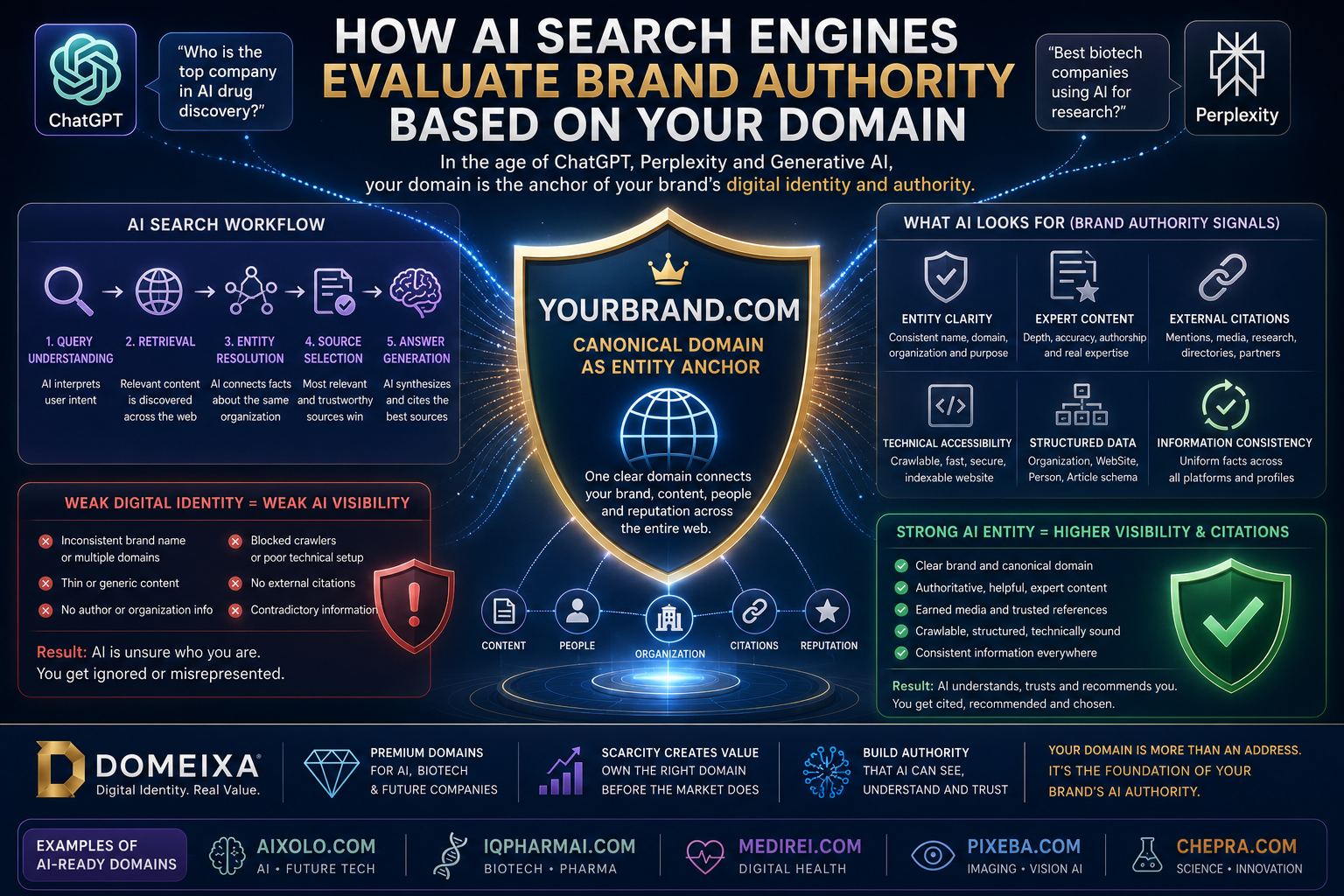
Public discussion often treats ChatGPT or Perplexity as if a single model permanently stores a ranking of every company. Modern AI search is more complex. Depending on the product and query, the system may interpret the request, generate one or more searches, retrieve web documents, evaluate relevance, select sources and synthesize an answer with citations.
OpenAI states that ChatGPT Search may rewrite a user’s question into targeted search queries and provide answers with links to relevant web sources. OpenAI also states that ranking is based on multiple factors designed to help users find reliable and relevant information, while making clear that no publisher can guarantee top placement.[1]
Perplexity describes its service as an AI-powered search engine that searches the web, synthesizes information from multiple sources and supports answers with links to original sources.[3]
A Simplified AI Search Pipeline
What company, product, category, location or comparison is the user asking about?
Which accessible pages and external sources are relevant to the question?
Do the company name, domain, profiles, products and citations refer to the same organization?
Which sources provide the clearest, most relevant and supportable evidence?
How should the retrieved evidence be summarized, attributed and cited?
What does “brand authority” mean in AI search?
AI-search authority is not one publicly documented score. It is better understood as a combination of signals that help a system conclude that a company is a real, relevant and sufficiently evidenced entity for a particular question.
Entity Clarity
The brand name, legal organization, domain, products and public profiles form one coherent identity.
Topical Relevance
The website provides substantial evidence that the company operates in the category being discussed.
Source Quality
Claims are supported by transparent evidence, named authors, primary sources and clear methodology.
Independent Corroboration
Relevant media, research, directories, partners or professional sources independently reference the brand.
Technical Accessibility
Crawlers can reach, render, understand and revisit the important pages without unnecessary barriers.
Information Consistency
Names, descriptions, facts, contact details and category positioning do not conflict across the web.
The domain as an entity anchor
A domain is the most durable web address controlled directly by a company. Social profiles, marketplace listings and media articles can change, disappear or remain under third-party control. The canonical domain can connect the organization’s official name, products, authors, policies, contact information, research and external profiles.
Google’s documentation provides a useful public example of entity disambiguation. Its site-name system considers home-page content and references appearing elsewhere on the web, while recommending one concise and consistently used site name. Google also states that Organization structured data can help it understand and disambiguate an organization in search results.[5][6]
ChatGPT and Perplexity do not publicly claim to use Google’s exact system. The practical inference is broader: machines have an easier task when the same company name, domain, logo, description and business category appear consistently across owned and independent sources.
| Domain Characteristic | Possible Strategic Benefit | What It Cannot Guarantee |
|---|---|---|
| Clear brand-domain match | Reduces ambiguity between the organization and its official website | Citation, recommendation or positive evaluation |
| Stable canonical .COM | Creates a durable address for links, mentions, structured data and content history | Authority without evidence or external recognition |
| Short memorable identity | Encourages consistent spelling in citations, media and customer references | Correct classification when the content is vague |
| Relevant specialist TLD | May communicate category context to human users | Preferential treatment by AI search |
| Clean historical continuity | Avoids repeated identity migrations and broken references | A direct domain-age ranking benefit |
Myth versus Reality
LLMs trust .COM domains and distrust every alternative TLD
There is no public evidence for such a universal rule. A high-quality website under .AI, .ORG, a national extension or another TLD can be retrieved and cited. A weak, misleading or inaccessible .COM can be ignored.
The stronger conclusion is that a premium .COM can reduce identity friction and improve long-term naming consistency. Authority still depends on relevance, evidence, crawlability, independent corroboration and the quality of the information available to the system.
How ChatGPT Search can discover and cite a brand
OpenAI states that any public website can appear in ChatGPT Search. For content to be more easily discovered, surfaced, cited and linked, publishers should allow OAI-SearchBot to access relevant pages. OpenAI separates this search crawler from GPTBot, which publishers can block when they do not want content considered for potential model training.[2]
This distinction matters. Allowing search discovery does not require treating every OpenAI crawler identically. A company can design a deliberate crawler policy based on whether it wants search visibility, model-training access or neither.
Illustrative robots.txt Direction
User-agent: OAI-SearchBot Allow: /

User-agent: PerplexityBot
Allow: /
The complete robots.txt configuration must reflect the company’s security, privacy, intellectual-property and indexing policy. Crawler access can also be blocked unintentionally by a CDN, WAF, bot-protection rule, authentication wall or JavaScript challenge.
OpenAI does not disclose a public list of domain-authority factors or a formula for earning citations. It states only that ChatGPT Search uses multiple factors intended to surface reliable and relevant information. Therefore, claims that a particular schema property, word count or domain extension guarantees ChatGPT visibility should be treated skeptically.
How Perplexity can discover and cite a brand
Perplexity describes PerplexityBot as the crawler used to surface and link websites in Perplexity search results. Its official documentation recommends allowing the bot in robots.txt and permitting traffic from its published IP ranges. Perplexity also operates Perplexity-User, which may access pages in response to a specific user request.[4]
Perplexity’s search experience is explicitly citation-oriented. The company states that answers synthesize multiple sources and include links that allow users to verify the information. This creates an opportunity for qualified websites, but also raises the standard: content must contain facts or explanations that are sufficiently clear and supportable to be selected as evidence.
What helps retrieval
- crawlable HTML and stable URLs,
- descriptive titles and headings,
- direct answers to specific questions,
- clearly attributable facts and definitions,
- visible publication and update context,
- primary documents and supporting sources.
What creates ambiguity
- several inconsistent brand names,
- duplicate sites on several domains,
- unclear ownership and contact information,
- unsupported marketing superlatives,
- pages that hide the main answer,
- contradictory facts across profiles.
Entity consistency: connect the brand, organization and domain
Entity consistency means that the company is represented with the same core facts wherever machines and users encounter it. The objective is not to repeat identical promotional copy everywhere. It is to eliminate contradictions about identity.
| Identity Element | Recommended Consistency | Common Problem |
|---|---|---|
| Brand name | One primary spelling and clearly defined alternative names | Different punctuation, spacing or abbreviations without explanation |
| Canonical domain | One official HTTPS address used across public profiles | Several domains displaying equivalent sites without clear canonicals |
| Legal organization | Visible relationship between the brand and legal entity | No ownership, company or contact information |
| Business description | A stable category definition with market-specific detail | The company describes itself differently on every platform |
| External profiles | Official profiles link back to the canonical domain | Profiles point to old or temporary domains |
| Products and authors | Clear relationships between people, products and organization | Anonymous content and undefined product ownership |
Google’s Organization structured-data guidance includes properties such as name, alternateName, url, logo, legalName, business identifiers and sameAs links. These fields do not guarantee AI-search citations, but they provide an explicit machine-readable description of the organization and its relationships.[6]
Structured data for a stronger machine-readable identity
Structured data should describe what is already visible and true on the website. It should not be used to manufacture authority or claim relationships that do not exist.
WebSite
Define the official site name, canonical home-page URL and legitimate alternative name.
Organization
Connect the brand with its legal identity, description, logo, contact information and authoritative profiles.
Article
Identify the headline, publication date, modification date, author, publisher and representative image.
Person
Describe identifiable experts, founders and authors when their identity is relevant to the content.
Product or SoftwareApplication
Clarify what the company offers instead of relying on broad marketing language.
BreadcrumbList
Expose the relationship between the home page, categories, resources and detailed pages.
Structured data improves explicitness. It does not independently prove expertise, quality or market leadership. Unsupported schema is not a substitute for visible content and verifiable external evidence.
Owned Media Is Not Enough
AI authority is strengthened when independent sources confirm the brand’s claims
A company can describe itself as innovative, trusted or market-leading on its own website. AI systems still need reasons to accept or repeat those claims. Independent coverage, research citations, professional listings, customer evidence, conference participation and credible partnerships can provide corroboration.
A 2025 research paper comparing AI-search sourcing reported a strong preference for earned third-party media over brand-owned and social content in its tested environments. The authors also found meaningful differences between AI-search platforms, languages and query formulations.[8]
What counts as useful third-party corroboration?
| External Evidence | Potential Entity Value | Quality Requirement |
|---|---|---|
| Industry media | Connects the brand with a category, event or development | Editorially independent and factually accurate coverage |
| Research and technical papers | Supports expertise and specific technical claims | Named authors, methodology and verifiable publication |
| Professional directories | Confirms category, location or organizational status | Controlled, maintained and relevant directory |
| Partner references | Confirms real commercial or technical relationships | Specific and independently published relationship |
| Reviews and customer cases | Provides evidence of use, results and market presence | Authentic, detailed and not artificially generated |
| Regulatory or public records | Helps identify the legal organization or regulated status | Official and applicable to the stated entity |
Content architecture for GEO and LLMO
Generative Engine Optimization and Large Language Model Optimization do not replace SEO. They extend it toward retrieval, citation and answer synthesis. The website must remain technically discoverable while presenting information in forms that machines can extract accurately.
Build one authoritative home page
Define the brand, category, audience, primary products, organization and canonical domain without vague slogans replacing factual explanation.
Create category and capability pages
Explain exactly what the company does, for whom, with which technologies and under which limitations.
Answer specific questions directly
Use concise definitions, quick answers, comparisons, tables, procedures and visible FAQ sections that can be extracted without losing context.
Publish evidence-rich resources
Include named sources, transparent methodology, original data, technical detail and clearly labelled interpretations.
Connect related content internally
Create understandable relationships between the brand, categories, research, products, authors and supporting articles.
Maintain factual freshness
Review time-sensitive facts, preserve publication history and show meaningful update dates instead of changing dates without substantive revision.
What the original GEO research actually demonstrated
The foundational Generative Engine Optimization paper introduced a benchmark for measuring visibility in generated answers and reported that selected content modifications could improve visibility by up to 40% within its experimental setting.[7]
This finding is important, but it should not be turned into a universal promise. A 2026 critical review of GEO research concluded that evidence remains narrow and that no reviewed technique had demonstrated a stable, longitudinal and cross-platform causal effect on organic discoverability or downstream business outcomes.[9]
The responsible GEO position
Optimise for accessibility, factual clarity, entity consistency, evidence and citation value. Do not promise that adding quotations, statistics, schema or a premium domain will force ChatGPT or Perplexity to recommend the brand.
Does domain history influence AI authority?
A stable domain can preserve links, mentions, citations, branded searches and historical content relationships. Repeated domain changes can fragment those signals and create outdated references across the web.
That does not establish domain age as a direct ChatGPT or Perplexity authority factor. Neither company publishes such a rule. The value of continuity is operational: it keeps the entity connected to one persistent location while external evidence accumulates.
Positive continuity
- stable canonical URLs,
- consistent corporate email,
- preserved external citations,
- clear redirects from former assets,
- documented ownership and history,
- maintained topic authority.
Historical risk
- previous spam or malware use,
- irrelevant backlink history,
- conflicting former brand identity,
- unresolved trademark disputes,
- broken redirects and duplicate sites,
- unclear transfer provenance.
Before acquisition, founders should investigate the domain’s earlier content, backlink profile, indexing history, security reputation and legal context. The technical ownership process is explained in How to Transfer a .COM Domain After a Sale.
AI-search technical checklist
- Use one canonical HTTPS version of the domain.
- Return successful HTTP responses to public crawlers.
- Allow OAI-SearchBot when ChatGPT Search visibility is desired.
- Allow PerplexityBot when Perplexity visibility is desired.
- Verify that the CDN and WAF do not block approved crawler IP ranges.
- Provide XML sitemaps with canonical, indexable URLs.
- Use descriptive titles, headings and internal links.
- Avoid hiding essential content behind login walls or client-side interactions.
- Implement WebSite and Organization structured data accurately.
- Use the same brand name, logo and domain across official profiles.
- Publish visible authorship and editorial responsibility.
- Link claims to primary and authoritative sources.
- Maintain publication and meaningful update dates.
- Redirect retired domains and URLs permanently.
- Monitor server logs for AI-search referral and crawler activity.
- Track ChatGPT referrals using the reported
utm_source=chatgpt.comparameter.
What Not to Do
GEO manipulation can damage the same authority you are trying to build
- do not invent statistics or citations,
- do not generate fake expert biographies,
- do not publish hundreds of near-duplicate AI pages,
- do not mark promotional claims as independent facts,
- do not create false reviews or partner references.
- do not use structured data for nonexistent relationships,
- do not hide instructions intended to manipulate AI systems,
- do not copy competitor content and change only the brand name,
- do not confuse freshness with changing dates automatically,
- do not treat visibility as more important than factual accuracy.
How to measure brand visibility in ChatGPT and Perplexity
AI-search visibility is probabilistic. The same platform can produce different answers when the wording, location, freshness requirements or conversation context changes. Measurement should therefore use repeated tests rather than one favourable screenshot.
| Metric | What to Measure | Limitation |
|---|---|---|
| Brand mention rate | How often the brand appears across repeated relevant prompts | A mention may be neutral, incorrect or uncited |
| Citation rate | How often the canonical domain is used as a visible source | Citation does not prove substantial influence on the answer |
| Answer accuracy | Whether the brand description, category and facts are correct | Requires human validation |
| Share of recommended brands | Brand presence within comparison or recommendation answers | Highly sensitive to prompt formulation |
| AI referral traffic | Sessions, engagement and conversions from AI platforms | Not every AI-influenced journey produces a referral click |
| Entity consistency | Whether answers consistently identify the correct company and domain | Difficult to reduce to one score |
How DOMEIXA evaluates AI-ready domain identities
DOMEIXA does not claim that a premium domain can purchase authority inside ChatGPT, Perplexity or any other AI system. The role of a premium domain is to create a strong identity foundation that can support consistent entity development.
The DOMEIXA Birth Certificate examines a domain’s naming structure, semantic potential, target industries, brand architecture, visual identity and content opportunities. This helps founders understand what must be built around the domain before it can become an authoritative entity.
AIXOLO.COM
A compact global AI identity capable of supporting a clearly defined technology organization and content ecosystem.
AIXOLY.COM
A future-facing identity for AI agents, automation and intelligent enterprise software.
AIPIXOL.COM
A specialist identity that connects artificial intelligence with visual, imaging and pixel-based technologies.
IQPHARMAI.COM
A category-rich identity for pharmaceutical intelligence, research analytics and AI-assisted drug development.
MEDIREI.COM
A medical and digital-health identity suitable for evidence-based content and professional entity development.
PIXEBA.COM
A visual-technology identity that can connect imaging products, expert resources and a recognisable corporate brand.
CHEPRA.COM
A distinctive global identity with room for a broader corporate, scientific or technology entity.
Explore further identities within AI & Startup Domains, Biotech & Gene, Aurum Domains and the premium Platinum Domains collection.
AI-search authority checklist
- Is one canonical domain clearly identified?
- Does the domain match the primary brand name?
- Is the legal organization connected to the brand?
- Are the same name and description used consistently?
- Can OAI-SearchBot and PerplexityBot reach the site?
- Are the important pages indexable and internally linked?
- Does the website explain the company’s category precisely?
- Are authors, experts and editorial responsibility visible?
- Are claims supported by primary sources?
- Does independent third-party evidence exist?
- Are WebSite and Organization data accurate?
- Are old domains and URLs redirected correctly?
- Is the historical domain reputation clean?
- Are facts and update dates reviewed regularly?
- Is AI-search visibility tested with repeated prompt variants?
- Are referral traffic and conversion outcomes measured?
Related DOMEIXA insights
AI-search authority is connected with brand identity, domain scarcity, secure ownership, digital trust and the long-term architecture built around the domain.
Why DOMEIXA Exists
Why future companies need a coherent digital identity before products and platforms are built.
The DOMEIXA Birth Certificate
How DOMEIXA reveals the strategic, semantic and commercial potential behind a domain.
Why Short .COM Names Are Rare
A complete analysis of scarcity, liquidity and premium-domain investment.
How to Transfer a .COM Domain After a Sale
The secure change-of-ownership and registrar-transfer process for premium domains.
Cheap TLDs and Phishing Risks for Startups
Why domain reputation, phishing exposure and identity clarity matter to technology companies.
Explore DOMEIXA
Discover curated domain identities for AI, biotechnology and future-ready digital companies.
Frequently asked questions about AI search, GEO and domains
1. Does ChatGPT rank .COM domains higher?
OpenAI does not publish a rule stating that .COM domains automatically rank higher. ChatGPT Search uses multiple factors intended to find reliable and relevant information.
2. Does Perplexity prefer premium domains?
Perplexity does not publicly state that premium domains receive preferential treatment. Its search system retrieves and cites web sources based on the query and available information.
3. What is GEO?
Generative Engine Optimization aims to improve how content is discovered, selected, cited or used within answers produced by AI-powered search and generative systems.
4. What is LLMO?
Large Language Model Optimization is an emerging term for improving how language-model systems understand, retrieve and represent a brand or its information.
5. Does a domain name define the company entity?
It is an important identity anchor, but the entity is also established through organization data, content, products, people, legal records and independent references.
6. Is domain age an AI-search ranking factor?
OpenAI and Perplexity do not publish domain age as a direct authority factor. Historical continuity can still preserve links, citations and entity consistency.
7. Should a website allow OAI-SearchBot?
Yes, when the publisher wants its public content to be eligible for inclusion in ChatGPT Search summaries and citations. Training access through GPTBot can be managed separately.
8. Should a website allow PerplexityBot?
Yes, when visibility in Perplexity search results is desired. The site’s WAF and CDN must also permit verified crawler traffic.
9. Does structured data guarantee AI citations?
No. Structured data can clarify identity and relationships, but citations depend on retrieval, relevance, evidence and platform-specific decisions.
10. Are third-party mentions important?
They can be highly valuable because independent sources corroborate a company’s identity, category, expertise and claims.
11. Can AI-generated articles improve GEO?
Only when they provide accurate, useful and distinctive information. Large volumes of generic or unsupported AI content can weaken credibility and retrieval value.
12. Is an FAQ useful for AI search?
A visible FAQ can provide clear question-and-answer units, but it should address genuine user questions and must not replace deeper evidence.
13. Should a company use several domains for separate topics?
Only when the projects are genuinely distinct. Splitting one brand across many weak sites can fragment content, links and entity signals.
14. How quickly can GEO results appear?
There is no guaranteed timeline. Crawling, indexing, source selection and answer generation vary by platform, query and content freshness.
15. What should a startup optimise first?
Begin with one stable identity, crawlable technical foundations, clear category positioning, evidence-rich content and consistent external references.
Build the Entity Before Expecting the Recommendation
GEO begins with a domain—but authority begins with everything built around it
A premium domain creates a clear and durable identity anchor. AI-search visibility emerges when that identity is connected to accessible technical infrastructure, structured organization data, authoritative content, independent evidence and consistent recognition across the web.
Explore the DOMEIXA portfolio and discover future-ready identities designed for AI, biotechnology and the next generation of digital companies.
Sources & References
- OpenAI — ChatGPT Search. How ChatGPT Search uses web queries, citations and multiple factors intended to surface reliable and relevant information.
- OpenAI — Publishers and Developers FAQ. Guidance on OAI-SearchBot, search inclusion, citation visibility and separate GPTBot controls.
- Perplexity — What Is Perplexity?. Official description of real-time web search, source synthesis and citation-backed answers.
- Perplexity — Perplexity Crawlers. Official documentation for PerplexityBot, Perplexity-User, robots.txt and WAF configuration.
- Google Search Central — Site Names in Google Search. Consistent site naming, WebSite structured data and references appearing elsewhere on the web.
- Google Search Central — Organization Structured Data. Organization disambiguation, official URL, legal name, logo, identifiers and sameAs relationships.
- Aggarwal et al. — GEO: Generative Engine Optimization. Foundational GEO framework, GEO-bench and experimental visibility findings.
- Chen et al. — Generative Engine Optimization: How to Dominate AI Search. Comparative research on source selection, earned media, language and platform differences.
- Martinez — Optimizing Visibility in Generative Engines: A Critical Survey of GEO, 2023–2026. Review of the current evidence base, limitations and absence of proven stable cross-platform discoverability techniques.
AI-search systems, crawler policies and retrieval behaviour change over time. Platform documentation should be rechecked before technical implementation. This article is educational and does not constitute a guarantee of rankings, citations, traffic, investment performance or commercial results.