
DOMEIXA® Blog • Cybersecurity & Digital Trust
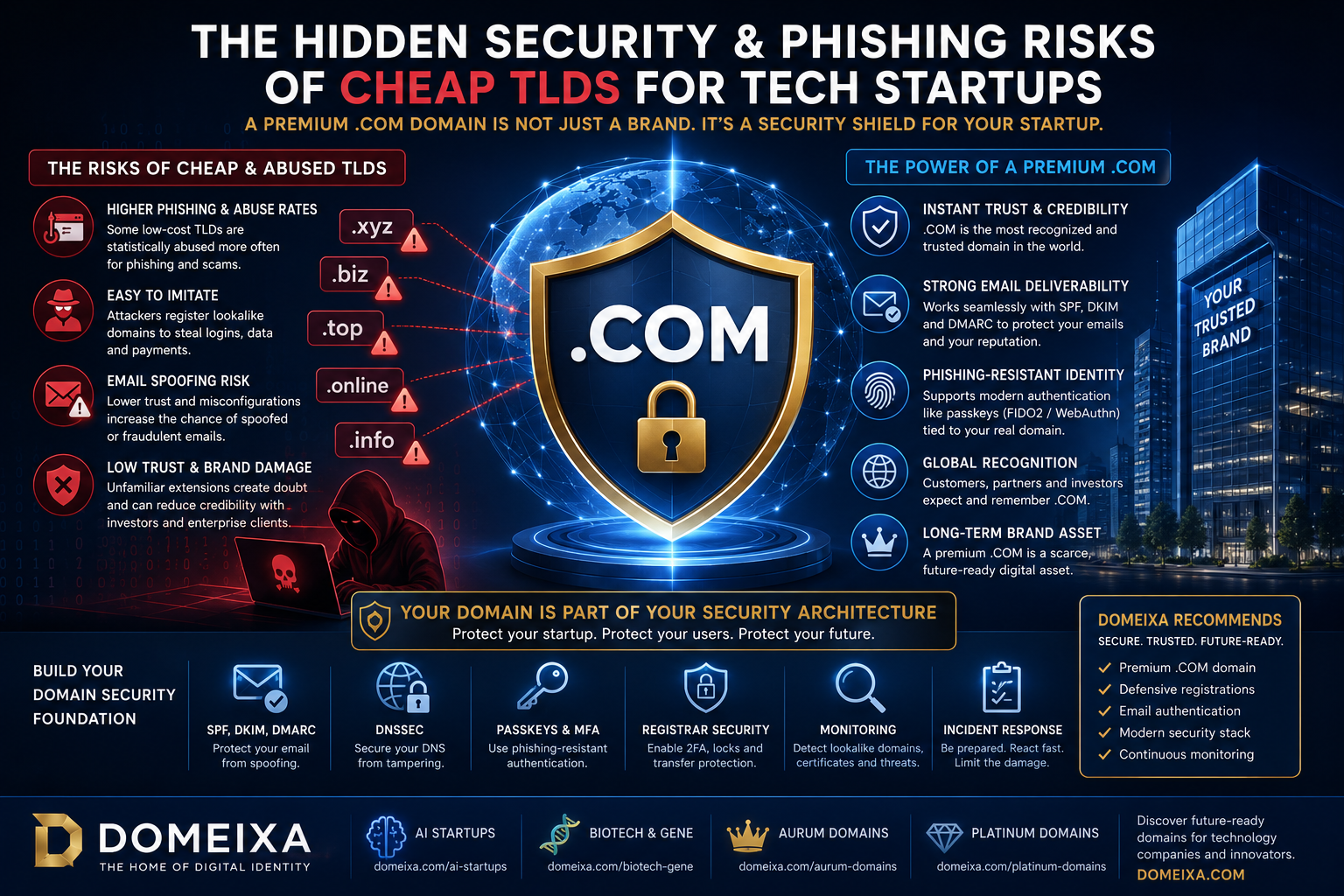
The Hidden Security and Phishing Risks of Cheap TLDs for Tech Startups
Why fintech, biotech, AI and enterprise startups should treat domain selection as part of their cybersecurity, email-authentication and institutional-trust architecture.
Core Principle
A premium domain is not a substitute for cybersecurity—but it can become an important layer of brand protection, identity control and institutional trust.
Quick answer: are cheap domain extensions a cybersecurity risk?
They can increase risk, but the extension alone does not make a domain malicious. Some inexpensive, heavily discounted or weakly governed namespaces attract a disproportionately high level of malicious registrations because attackers can acquire domains quickly, cheaply and at scale. However, legitimate companies also use alternative extensions successfully, while many phishing attacks occur under .COM because it is the world’s largest namespace. The correct security question is therefore not “Is this extension bad?” but “What level of abuse, identity confusion and reputational friction does this domain strategy create for our particular company?”
Why the domain is part of the startup security perimeter
A domain is often described as a website address. For a technology company, it is much more. It becomes the namespace used for corporate email, employee accounts, customer portals, API documentation, investor communication, cloud services, authentication callbacks, support systems and password recovery.
This makes the domain a security boundary. Attackers do not always need to compromise the legitimate website. They can register a confusingly similar name, create a convincing login page and send an email that appears to come from the founder, finance department, laboratory or compliance team.
The risk is especially serious when the company operates in fintech, biotechnology, medical technology, pharmaceuticals, enterprise AI or cybersecurity. These industries handle money, credentials, intellectual property, sensitive research, regulated information and high-value commercial relationships.
Website Identity
The canonical destination customers and partners are expected to recognise.
Email Identity
The domain used to authenticate executive, finance, research and support communication.
Authentication Boundary
Passkeys and modern authentication protocols verify the domain where credentials are being used.
Reputation Layer
Customers, investors, security tools and email providers form expectations around the domain’s history and behaviour.
The Current Threat Landscape
Phishing is not a marginal risk—it is industrialised digital fraud
The Anti-Phishing Working Group recorded 971,181 phishing attacks in the first quarter of 2026, representing a 13.8% increase from the previous quarter. Telecom and SaaS or webmail services were among the most frequently targeted sectors.[1]
Interisle’s Phishing Landscape 2025 study analysed nearly four million reports and identified almost two million phishing attacks during the twelve-month study period—more than 180% above the level recorded in 2021.[2]
Common startup attack objectives
- stealing employee credentials,
- redirecting supplier payments,
- impersonating founders or executives,
- capturing customer logins,
- obtaining API keys or cloud access,
- stealing research or clinical information,
- distributing malware through trusted relationships.
Absolute phishing volume and abuse rate are not the same measurement
.COM has the largest absolute number of reported phishing domains because it is also by far the largest commercial namespace. That fact does not mean every .COM domain is safer, and it does not mean every alternative extension is dangerous.
A more useful comparison divides reported phishing domains by the approximate number of delegated domains in each extension. Interisle’s 2025 dataset expressed this as a phishing-domain score per 10,000 delegated domains.[3]
| TLD | Approximate Delegated Domains | Reported Phishing Domains | Phishing Score per 10,000 |
|---|---|---|---|
| .COM | 154,712,032 | 455,297 | 29.4 |
| .XYZ | 4,219,839 | 73,509 | 174.2 |
| .TOP | 3,525,239 | 187,749 | 532.6 |
| .BOND | 454,090 | 79,875 | 1,759.0 |
| .INFO | 3,871,727 | 44,540 | 115.0 |
| .ONLINE | 2,950,523 | 33,414 | 113.3 |
The results describe activity during one defined measurement period. They do not prove that every domain under a listed extension is unsafe, and they do not measure the quality of a specific startup. Abuse rates change as pricing, registrar controls, registry policies and criminal behaviour evolve.
Why low-cost registrations attract attackers
Phishing campaigns depend on economics. A criminal operator may register hundreds or thousands of domains knowing that many will be blocked, suspended or abandoned within days. Low registration prices, automated account creation, bulk-registration APIs, weak verification and slow abuse response can reduce the cost of that operating model.
A longitudinal academic study covering 690,502 unique phishing domains found that 66.1% of the analysed domains were maliciously registered rather than legitimate domains later compromised. The researchers identified repeated use of cost-effective TLDs and alternative extensions to imitate established brands.[4]
Spamhaus also evaluates TLD reputation through a combination of the number of malicious domains, the number of active domains observed and the overall scale of the namespace. Its methodology emphasises that a large TLD can contain many malicious domains in absolute terms while still having a comparatively low proportion, whereas a smaller namespace may show a severe concentration of abuse.[5]
Low Entry Cost
Attack infrastructure becomes disposable when registrations cost less than the value of one stolen account.
Bulk Automation
Automated registrations allow multiple spelling variants and campaign domains to be created at once.
Rapid Churn
Attackers replace blocked domains quickly instead of building long-term reputation.
Lookalike Supply
Alternative extensions provide many opportunities to combine a trusted brand name with an unfamiliar ending.
Myth versus Reality
A premium .COM domain automatically protects a startup from phishing
False. A .COM domain cannot prevent an attacker from registering a typo, compromising an employee, cloning a login page or sending a forged message. It does not replace MFA, DMARC, DNSSEC, registrar security, monitoring or employee training.
The more accurate principle is this: a strong .COM can establish one clear canonical identity, reduce naming ambiguity, support professional email, make defensive registrations easier to organise and provide a stable foundation for the technical controls that actually protect the company.
Why fintech and biotech face a higher trust burden
Fintech
Money, identity and irreversible transactions
Fintech companies ask users and business customers to trust them with payments, bank connections, financial records, identity documents and transaction instructions.
A confusing or disposable-looking domain can increase hesitation during onboarding and may make impersonation emails more believable. Business email compromise can redirect invoice payments or create fraudulent instructions that appear to come from a founder, CFO or banking partner.
Biotech & Life Sciences
Research, intellectual property and sensitive partnerships
Biotechnology companies exchange confidential research, laboratory reports, clinical information, patent material, supplier instructions and investor documents.
Attackers may impersonate a laboratory, research partner, pharmaceutical company or executive to obtain credentials, redirect shipments, access files or compromise intellectual property. A consistent corporate domain helps partners identify the expected communication channel.
For these sectors, a domain should be evaluated together with the company’s complete identity architecture. DOMEIXA explores this principle in Why a Premium .COM Domain Still Matters in the Age of AI and within the curated Biotech & Gene domain collection.
The main domain-based attack patterns
| Attack Pattern | Example | Primary Risk | Defensive Response |
|---|---|---|---|
| Typosquatting | Replacing, omitting or repeating one character | Users overlook a small spelling difference | Register critical typo variants and monitor new domains |
| Alternative-TLD impersonation | Brand name under .top, .xyz, .info or another extension | The visible brand word appears correct | Publish and repeat the canonical domain consistently |
| Homoglyph attack | Visually similar characters from another alphabet | The fraudulent address looks almost identical | IDN monitoring, browser protection and defensive registration |
| Subdomain deception | trusted-brand.example-attacker.com | Users read the first words instead of the registered domain | User education and URL inspection |
| Email spoofing | Forged From address using the legitimate domain | Fraudulent payment or credential request | SPF, DKIM, DMARC and reporting |
| Compromised domain | A legitimate site or subdomain is hijacked | Existing reputation makes the attack more convincing | Patching, access control, logging and incident response |
A strong domain must be supported by technical security controls
The domain creates the identity layer. Technical controls determine whether that identity can be authenticated, protected and recovered.
SPF, DKIM & DMARC
Authenticate authorised email senders, sign messages and instruct receiving systems how to handle unauthenticated mail.
DNSSEC
Cryptographically validates DNS responses and helps prevent forged DNS data from redirecting users.
Registrar Protection
Use MFA, strong recovery controls, transfer locks, change notifications and restricted administrator access.
Phishing-Resistant MFA
Passkeys and FIDO2 authenticators bind authentication to the genuine domain instead of relying only on reusable codes.
Certificate & Domain Monitoring
Detect newly registered lookalikes, suspicious certificates, altered DNS records and fraudulent login pages.
Incident Response
Define who contacts registrars, hosting providers, certificate authorities, customers and law enforcement after impersonation is detected.
Email authentication: where domain reputation becomes operational
Google’s sender guidelines require all senders to use SPF or DKIM and require higher-volume senders to implement SPF, DKIM and DMARC. Google states that authenticated messages help protect recipients against spoofing and phishing and are less likely to be rejected or marked as spam.[6]
| Control | What It Verifies | What It Does Not Solve |
|---|---|---|
| SPF | Which servers are authorised to send for a domain | Lookalike domains and compromised authorised accounts |
| DKIM | Whether a message carries a valid cryptographic signature | Fraud sent from a different but similar domain |
| DMARC | Alignment between the visible From domain and SPF or DKIM identity | Social engineering from a separately registered impersonation domain |
Begin with SPF, DKIM and DMARC reporting, identify every authorised sender and gradually move toward a DMARC enforcement policy. Monitor aggregate and forensic signals before rejecting mail to avoid disrupting legitimate systems.
Why passkeys make the domain itself part of authentication
NIST identifies WebAuthn and FIDO2 as examples of phishing-resistant authentication because the authenticator is cryptographically bound to the authenticated verifier name—the legitimate website domain. A passkey created for the real company domain cannot simply be replayed on an attacker’s lookalike website.[7]
Microsoft similarly warns that traditional SMS, email-code and push-notification MFA can be intercepted, spoofed or abused through man-in-the-middle attacks and MFA fatigue. It recommends phishing-resistant credentials such as passkeys and FIDO2 security keys for stronger identity protection.[8]
Security implication for founders
When the corporate domain becomes the stable verifier for passkeys, login systems, email and customer portals, changing that domain later is no longer merely a branding exercise. It becomes an identity migration affecting users, credentials, integrations and security policy.
DNSSEC: important protection with a defined scope
DNSSEC adds cryptographic signatures to DNS data so validating resolvers can detect unauthorised modification. ICANN explains that this can prevent forged DNS responses from redirecting users to deceptive infrastructure.[9]
DNSSEC does not evaluate whether the website itself is honest, and it does not stop an attacker from registering another domain. It protects the authenticity of DNS information for the secured domain. It should therefore be viewed as one component of defence in depth.
DNSSEC can help protect against
- forged DNS responses,
- cache-poisoning scenarios,
- undetected DNS-record modification in the validation chain.
DNSSEC does not prevent
- typosquatting,
- alternative-TLD impersonation,
- stolen employee credentials,
- malicious content on an authenticated domain.
Premium .COM as a brand-security layer
A premium .COM is most valuable when it creates one clear, authoritative and memorable digital identity. Customers should not need to wonder whether the real company uses the .com, .ai, .io, .xyz or a hyphenated alternative.
For a startup, this clarity can reduce what may be called identity ambiguity: the number of plausible domains that could appear to represent the business. Lower ambiguity does not eliminate impersonation, but it gives customers, employees, journalists, investors and security teams a stronger reference point.
This strategic role of a premium domain is explored in Why Choose DOMEIXA? Premium Domains for Future Brands and Why DOMEIXA Exists: Future-Ready Digital Identity.
| Domain Strategy | Potential Advantage | Potential Security or Trust Cost |
|---|---|---|
| Strong premium .COM | Clear global identity, familiar email format and long-term scalability | Higher acquisition cost and continued need for defensive controls |
| Relevant specialist TLD | Immediate category association, such as .ai | Users may still assume or visit the .COM equivalent |
| Low-cost alternative TLD | Low initial cost and wider name availability | Possible reputational friction, confusion and increased explanation cost |
| Hyphenated or compromised name | May preserve important keywords | Typing errors, verbal ambiguity and traffic leakage |
Defensive domain strategy: what should a startup register?
Registering every possible variation is usually neither practical nor economically justified. Defensive registration should focus on the variants most likely to confuse customers or support fraud.
Secure the canonical domain
Acquire the name that will appear on the website, email, investor materials, legal documents and products.
Register critical misspellings
Prioritise missing letters, repeated letters, transpositions and pronunciation-driven spelling variants.
Protect strategically relevant extensions
A .COM company may also secure the relevant national domain, .ai or another extension that customers are likely to assume.
Redirect defensive domains
Use permanent redirects to the canonical website instead of creating duplicate sites or unmaintained landing pages.
Monitor what cannot be registered
Use domain, certificate and brand monitoring to identify suspicious new registrations that require investigation or enforcement.
Investor and B2B Perspective
Institutional trust is created by consistency—not by the extension alone
Investors and enterprise buyers do not perform due diligence by checking only whether a company owns a .COM. They examine the legal entity, team, product, security controls, regulatory position, financial information, contracts and market evidence.
A premium domain can nevertheless reduce avoidable friction. A professional website and matching corporate email create a consistent identity across investor presentations, virtual data rooms, procurement documents, security questionnaires and partnership communication.
How DOMEIXA evaluates domains for high-trust industries
DOMEIXA does not classify a domain as secure merely because it uses .COM. The evaluation considers whether the name can support a clear company identity, professional email, global communication, defensive registration, long-term brand architecture and a credible role in its intended industry.
The proprietary DOMEIXA Birth Certificate examines the strategic potential behind each selected identity, while the article Domain Investing: Why Short .COM Names Are Rare explains the scarcity and commercial structure of premium digital assets.
IQPHARMAI.COM
A pharmaceutical-intelligence identity for AI-assisted research, analytics and advanced drug-development platforms.
MEDIREI.COM
A scalable identity for medical technology, healthcare intelligence and digital diagnostics.
AIXOLY.COM
A compact identity for AI software, autonomous agents and intelligent enterprise infrastructure.
AIXOLO.COM
A premium global technology identity with room for a broader AI and digital-services ecosystem.
AIPIXOL.COM
A specialist identity for visual AI, imaging systems and creative intelligence.
PIXEBA.COM
A memorable digital identity for imaging, media, design or visual-technology platforms.
CHEPRA.COM
A distinctive corporate identity with international brand and platform potential.
Domain security checklist for a technology startup
- Is the canonical domain clear and easy to communicate?
- Are the most dangerous typo variants protected?
- Are relevant national or specialist extensions secured?
- Is the registrar account protected with strong MFA?
- Are transfer locks and change notifications enabled?
- Is DNSSEC supported and correctly configured?
- Are website and email domains aligned?
- Are SPF and DKIM correctly deployed?
- Is DMARC reporting enabled and reviewed?
- Are privileged accounts protected by passkeys or FIDO2?
- Are certificates and lookalike domains monitored?
- Is the domain renewal automated and independently monitored?
- Are recovery contacts current and tightly controlled?
- Is there a documented impersonation-response process?
- Do employees know how to verify payment instructions?
- Is the complete domain portfolio recorded as a corporate asset?
Related DOMEIXA insights
A secure domain strategy should be developed together with naming, acquisition, transfer, brand architecture and long-term company positioning.
Why DOMEIXA Exists
Why future companies need a coherent digital identity before they launch.
The DOMEIXA Birth Certificate
How DOMEIXA reveals the market, branding and architectural potential behind a domain.
Why Short .COM Names Are Rare
A market analysis of short domains, scarcity, liquidity and premium digital assets.
How to Transfer a .COM Domain After a Sale
The complete procedure for changing ownership through FORPSI, GoDaddy or Dynadot.
Why Choose DOMEIXA?
The difference between an anonymous marketplace and a curated portfolio of future brands.
Why Premium .COM Domains Still Matter in the Age of AI
Why identity, familiarity and long-term control remain important as AI accelerates company creation.
Frequently asked questions about TLD security and phishing
1. Is every cheap domain extension unsafe?
No. Price and extension are risk signals, not proof of abuse. Legitimate organisations use many alternative extensions, and the security of a specific domain depends on its owner, infrastructure, history and controls.
2. Is .COM free from phishing?
No. .COM has the largest absolute number of reported phishing domains because it is also the world’s largest namespace. Its proportional abuse rate may nevertheless be lower than that of some smaller extensions.
3. Does a premium .COM automatically make a startup trustworthy?
No. Trust depends on the company, product, legal identity, security controls and behaviour. A strong domain can reduce identity friction and provide a more credible foundation.
4. Why are low-cost TLDs attractive to criminals?
Attackers often need disposable domains in large numbers. Low prices, promotions, automated registrations and weak verification can reduce the cost of phishing campaigns.
5. Is .XYZ unsuitable for a legitimate startup?
Not automatically. Some legitimate brands use .XYZ successfully. The founder must weigh category fit and availability against abuse statistics, user familiarity, email reputation and possible confusion with the .COM equivalent.
6. Is .BIZ inherently insecure?
No extension should be declared unsafe without current evidence. Abuse patterns change over time, and the security of an individual domain must be assessed separately.
7. What is typosquatting?
Typosquatting is the registration of a confusingly similar domain using a spelling error, omitted character, extra character or transposed letters.
8. What does DMARC protect?
DMARC helps prevent unauthorised senders from successfully spoofing the legitimate domain in the visible From address. It does not block email from separate lookalike domains.
9. Does DNSSEC stop phishing?
DNSSEC protects the authenticity of DNS responses. It does not determine whether a website is fraudulent and does not prevent attackers from registering another domain.
10. Why are passkeys resistant to phishing?
WebAuthn passkeys are cryptographically bound to the genuine domain, so credentials created for the legitimate website cannot simply be reused on a lookalike domain.
11. Should a startup register every alternative extension?
Usually not. Defensive registration should focus on the variants customers are most likely to assume or mistype, supported by monitoring for the remaining risks.
12. Why is domain security important before fundraising?
The domain appears across investor communication, data rooms, legal documents and email. Consistent identity and strong security reduce avoidable questions and impersonation risk.
13. Can a company migrate to a premium domain later?
Yes, but migration can affect email, authentication, customer accounts, certificates, links and integrations. Choosing the long-term identity before launch can reduce future technical debt.
Sources & References
- Anti-Phishing Working Group — Phishing Activity Trends Reports. Q1 2026 phishing volume, quarterly growth and targeted sectors. :contentReference[oaicite:0]{index=0}
- Interisle Consulting Group — Phishing Landscape 2025. Twelve-month phishing study and historical growth analysis. :contentReference[oaicite:1]{index=1}
- Cybercrime Information Center — Phishing Activity in Top-Level Domains. TLD size, reported phishing domains and phishing-score methodology for May 2024–April 2025. :contentReference[oaicite:2]{index=2}
- Registration, Detection, and Deregistration: Analyzing DNS Abuse for Phishing Attacks. Longitudinal research covering 690,502 phishing domains. :contentReference[oaicite:3]{index=3}
- Spamhaus — Reputation Statistics Methodology. Explanation of TLD reputation scoring and limitations of observed-domain datasets. :contentReference[oaicite:4]{index=4}
- Google — Email Sender Guidelines. SPF, DKIM, DMARC, TLS and sender-authentication requirements. :contentReference[oaicite:5]{index=5}
- NIST SP 800-63B — Authenticators. WebAuthn, FIDO2 and verifier-name binding as phishing-resistant authentication. :contentReference[oaicite:6]{index=6}
- Microsoft Secure Future Initiative — Phishing-Resistant MFA. Risks of traditional MFA and recommendations for passkeys and FIDO2 credentials. :contentReference[oaicite:7]{index=7}
- ICANN — Domain Name System Security Extensions. Definition and security purpose of DNSSEC. :contentReference[oaicite:8]{index=8}
- ICANN DNS Abuse Mitigation Program. Definitions of phishing, malware, botnets, pharming and related DNS abuse. :contentReference[oaicite:9]{index=9}
Security and abuse data changes over time. TLD-level statistics should be interpreted as ecosystem indicators, not as a verdict on every domain using a particular extension. This article is educational and does not constitute legal, cybersecurity, regulatory or investment advice.
Build Trust Before the First Login
A premium domain is not merely a marketing expense. Properly secured, it becomes part of the company’s identity and defence architecture
The strongest startup domain creates one recognisable destination for customers, investors, partners, employees and authentication systems. Its value emerges when a clear identity is combined with email authentication, phishing-resistant access, DNS protection, defensive registration and active monitoring.
Explore the DOMEIXA portfolio and discover future-ready identities created for technology, AI, biotechnology and high-trust digital industries.