
DOMEIXA® Blog • Marketing Efficiency & Domain ROI
The Radio Test: How a Premium Domain Lowers Your Customer Acquisition Cost
Why pronunciation, spelling, memorability and domain-extension clarity influence the amount of paid media required to turn awareness into customers.
Core Principle
Every time a prospect must ask how to spell your name, remember a hyphen or identify an unfamiliar extension, part of your marketing investment is placed at risk.
Quick answer: can a premium domain reduce customer acquisition cost?
Yes, it can—but not automatically and not by changing an advertising platform’s auction formula. A memorable domain can reduce address confusion, misspellings, search detours, traffic leakage, failed referrals and the amount of advertising required to teach customers how to find the company. Its financial value is greatest when the brand depends on podcasts, video, word of mouth, events, outbound sales, public relations or any channel where people hear the name before they see it.
What is the Radio Test?
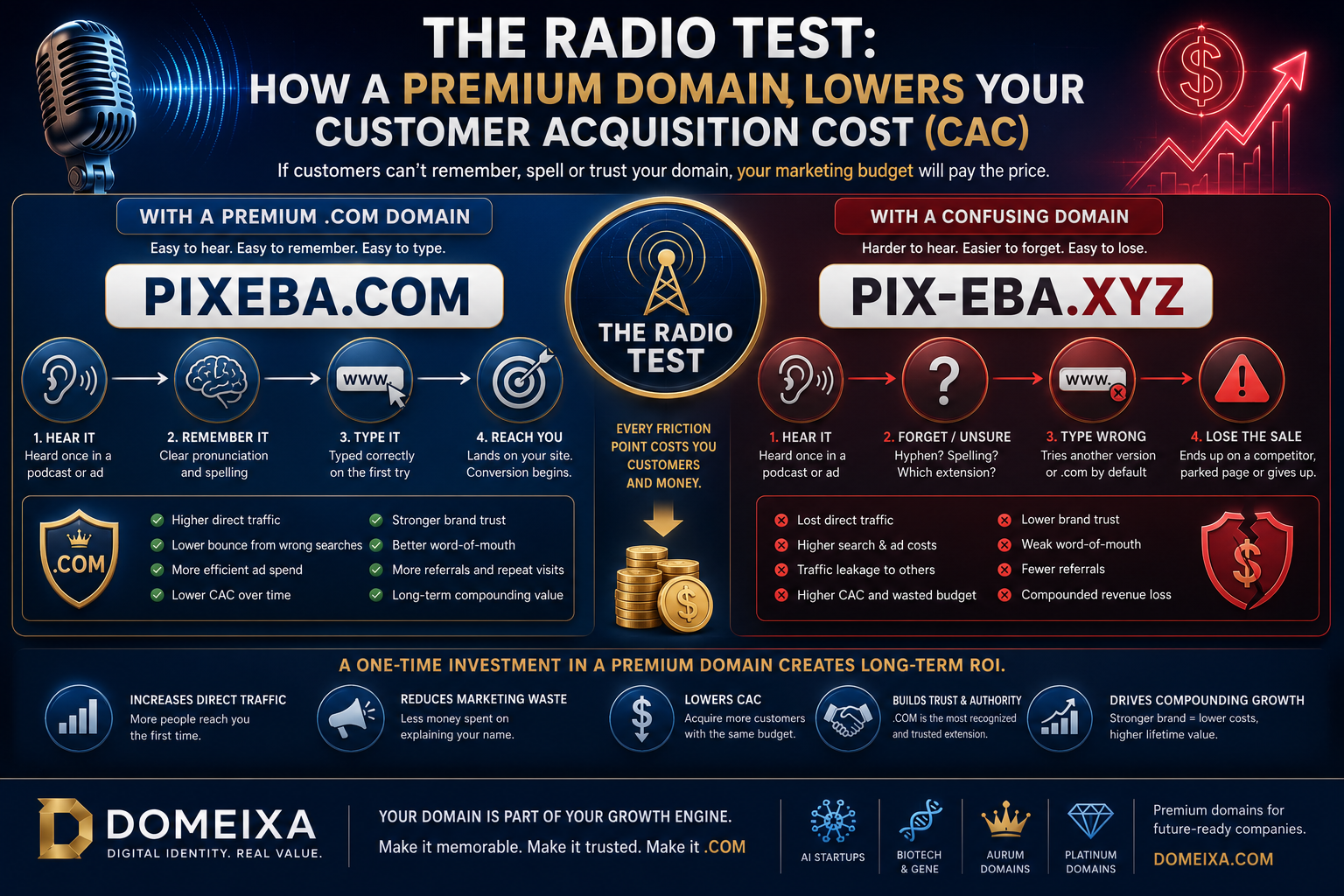
The Radio Test is a practical naming test rather than an official advertising metric. A brand passes when a person can hear the company or domain name once and then pronounce, remember and type it correctly without seeing it written down.
Imagine that a founder mentions the company during a podcast interview. The listener is driving, walking or working and cannot immediately click a link. Ten minutes later, can that listener enter the correct address into a browser?
A Domain Passes the Test When
The listener can reconstruct the digital address from sound alone
- the brand has one intuitive pronunciation,
- the spelling follows naturally from the sound,
- there is no hidden hyphen,
- letters and numbers cannot be confused,
- the singular or plural form is obvious,
- the extension is expected and remembered,
- the complete name remains understandable across the intended markets.
The critical question
“If someone hears this name once, will they reach our website—or will they search for us, guess another extension or visit somebody else?”
Research on processing fluency provides a scientific foundation for this practical test. Experimental work has found that easier-to-pronounce names tend to be evaluated more positively, while financial research has reported associations between fluent company names and broader investor recognition, trading activity and valuation measures.[1][2]
These studies concern names, processing fluency and investor or consumer responses. They do not prove that every premium domain produces a specific percentage reduction in CAC. Applying the findings to domain strategy is a commercially reasonable inference that should be tested with the company’s own marketing data.
Why memorability matters to customer acquisition cost
Customer acquisition cost is commonly expressed as the total sales and marketing cost required to acquire a defined number of new customers:
Basic CAC Formula
CAC = Total acquisition cost ÷ New customers acquired
The domain affects neither side of this equation by itself. It influences the journey between advertising exposure and successful arrival. If prospects misunderstand, forget or mistype the address, part of the paid awareness never reaches the intended landing page.
Exposure
The prospect hears or sees the brand through paid, earned or owned media.
Recall
The prospect must retain enough of the name to search for it or enter the address.
Reconstruction
The listener converts the remembered sound into letters, punctuation and a TLD.
Arrival
Only successful arrival allows the landing page and conversion funnel to begin working.
The hidden forms of marketing leakage
Domain friction rarely appears as one clear line in an analytics dashboard. It is distributed across lost direct visits, branded searches, mistaken clicks, failed email communication and prospects who abandon the journey completely.
| Friction Source | Customer Behaviour | Possible Marketing Cost |
|---|---|---|
| Difficult spelling | The customer tries several variants or gives up | Lost direct traffic and additional branded-search dependence |
| Hidden hyphen | The customer enters the non-hyphenated version | Traffic leakage to another owner or parked domain |
| Unexpected TLD | The customer assumes .COM or searches for the brand | More paid brand traffic and exposure to competitors |
| Number ambiguity | The user cannot tell whether to enter 4, four or for | Incorrect visits and reduced referral conversion |
| Singular versus plural | The user remembers the category but not the exact form | Split traffic and increased need for defensive registration |
| Pronunciation uncertainty | Different people pronounce and spell the brand differently | Lower word-of-mouth efficiency and repeated explanation |
| Technical acceptance | An application rejects or mishandles a valid new TLD or email address | Failed sign-ups, forms or partner onboarding |
ICANN’s Universal Acceptance programme exists because not every application and system has historically processed every valid TLD and email address correctly. This does not make newer extensions invalid, but it demonstrates that technical acceptance can become another source of friction in certain workflows.[3]
Where the Radio Test Matters Most
Audio-first channels expose every weakness in the domain
- podcast interviews and sponsorships,
- radio advertising,
- streaming-audio campaigns,
- conference presentations,
- webinars and live discussions,
- telephone sales and customer support.
- word-of-mouth recommendations,
- investor introductions,
- video content without clickable links,
- voice-assistant searches,
- out-of-home advertising viewed briefly,
- networking and trade-show conversations.
A visual advertisement can display punctuation and the extension. A spoken recommendation cannot. The listener must rebuild the address from memory, making every unnecessary naming decision a potential point of failure.
A simple model of domain-related CAC leakage
The financial effect can be modelled without pretending that one universal leakage rate applies to every company. Assume that all other variables remain unchanged and define the address-loss rate as the share of intended responders who fail to reach the correct website because of naming or domain confusion.
Illustrative Domain-Friction Model
Effective CAC = Base CAC ÷ (1 − address-loss rate)
| Assumed Address-Loss Rate | Effective CAC Multiplier | Extra Cost per Acquired Customer |
|---|---|---|
| 2% | 1.020× | Approximately 2.04% higher |
| 5% | 1.053× | Approximately 5.26% higher |
| 10% | 1.111× | Approximately 11.11% higher |
| 15% | 1.176× | Approximately 17.65% higher |
| 20% | 1.250× | Approximately 25% higher |
This table is a mathematical illustration, not an industry benchmark. It demonstrates why even a modest amount of preventable traffic loss can become expensive when repeated across years of advertising, public relations and sales activity.
A campaign with a base CAC of USD 100 would produce an effective CAC of approximately USD 111.11 if 10% of otherwise qualified responders failed to reach the correct address. Reducing that loss from 10% to 2%, while holding every other variable constant, would reduce the modelled CAC from approximately USD 111.11 to USD 102.04.
Does a premium domain directly reduce Google Ads CPC?
No direct rule says that an expensive, short or premium domain receives cheaper clicks. Google describes ad quality in terms of expected click-through rate, ad relevance and landing-page experience. Higher-quality ads generally perform better and can cost less, but the purchase price or prestige of the domain is not listed as an auction-quality component.[4]
What a premium domain does not guarantee
- a higher Quality Score,
- lower auction bids,
- better organic rankings,
- a higher conversion rate,
- successful advertising creative,
- product-market fit.
What it can support indirectly
- greater confidence before clicking,
- consistent ad-to-landing-page identity,
- easier brand recall after exposure,
- more efficient offline attribution,
- fewer mistaken direct visits,
- stronger long-term branded demand.
Google also recommends consistency between the user’s search, the advertisement and the landing-page experience. A clear domain and brand architecture can support that consistency, but the benefit must still be earned through relevant ads, useful pages and a credible offer.[5]
Myth versus Reality
The shortest domain always produces the best marketing ROI
False. A short sequence that is impossible to pronounce, easily confused or commercially meaningless may perform worse than a slightly longer but intuitive brand.
The objective is not minimum character count at any cost. The objective is minimum cognitive friction while preserving distinctiveness, credibility, meaning and legal usability.
What usually causes a domain to fail the Radio Test?
| Domain Characteristic | Spoken Ambiguity | Better Strategic Response |
|---|---|---|
| Hyphenated name | The listener does not know a hyphen is present | Own the non-hyphenated version or reconsider the name |
| Letter-number combination | “Two” may mean 2, two or to | Use a number only when it is integral and obvious |
| Invented spelling | Several plausible spellings follow the same sound | Test unaided transcription before committing |
| Unexpected extension | The listener remembers the name but assumes .COM | Secure the .COM or repeat the full address consistently |
| Multiple repeated letters | The number of repeated characters is unclear | Simplify the spelling or own the main error variants |
| Long compound phrase | Word order and boundaries are forgotten | Create a shorter master brand and use descriptive page URLs |
| Cross-language inconsistency | Pronunciation changes between target markets | Run the test with native speakers in each core market |
Why .COM often reduces explanation cost
.COM does not make a weak name strong, but it frequently removes one question from the customer journey: “Which extension was it?” Its global commercial familiarity makes it a common default assumption in spoken communication.
At the end of 2025, Verisign reported approximately 161 million registered .COM domains, making .COM the largest individual commercial namespace. Scale is not proof that every .COM is trustworthy or valuable, but it does help explain why the extension is deeply embedded in user expectations.[6]
Alternative extensions can work exceptionally well when the ending is central to the positioning, understood by the audience and consistently communicated. The challenge arises when the brand must repeatedly explain that it is “not the .COM,” especially when another party owns the matching .COM address.
| Domain Strategy | Potential Advantage | Potential Marketing Friction |
|---|---|---|
| Short premium .COM | Familiar extension, compact presentation and scalable identity | Higher acquisition cost and limited availability |
| Relevant specialist TLD | Immediate category association | Some users may still visit the corresponding .COM |
| National ccTLD | Strong local trust and geographical relevance | Less natural for a global master brand |
| Hyphenated compromise | Lower acquisition price and descriptive clarity when written | Weak verbal transmission and leakage to the unhyphenated address |
Domain clarity strengthens brand search and attribution
A memorable domain can create a cleaner path from awareness to branded demand. After hearing the name, the prospect may enter the address directly or search for the exact brand. Both behaviours are easier to attribute than a vague category search in which the company must compete again for attention.
Google displays a site name alongside search results and generates it from signals that include home-page content, structured data and external references. A consistent brand name across the domain, website, advertising and public profiles helps search systems and users recognise the source.[7]
This does not mean that a premium domain receives an organic ranking bonus. The value lies in creating a stable identity around which brand searches, citations, links, mentions and repeat visits can accumulate.
The relationship between scarcity, domain quality and commercial value is explored in Domain Investing: Why Short .COM Names Are Rare.
Beyond Advertising
The same domain also affects sales, recruitment, investment and partnerships
A founder may first evaluate the domain as a marketing asset, but the address appears throughout the entire company: sales calls, proposals, email, contracts, investor decks, job advertisements, supplier onboarding and press coverage.
Every employee who must repeatedly explain the spelling creates an operational cost. Every partner who sends an email to the wrong address creates delay. Every investor who searches for the company and encounters another site experiences unnecessary friction.
A professional Radio Test protocol
Founders should test the complete digital address, not merely ask whether people “like” the brand name.
Recruit people who have never seen the name
Existing team members already know the correct spelling and cannot provide an unbiased result.
Say the name once in a normal sentence
Do not slow down, spell it, emphasise the extension or reveal the visual identity.
Ask participants to write the complete domain
Record errors in the brand spelling, punctuation, plural form, numbers and extension separately.
Repeat the recall test after a delay
A name that can be transcribed immediately may still be forgotten after ten minutes or one day.
Test every strategic language market
A globally scalable domain must avoid unwanted meanings and unstable pronunciation across core countries.
Compare performance, not opinions
Measure correct transcription, delayed recall and the number of alternative spellings generated by participants.
Set a required correct-transcription rate before approving a name. The threshold should be stricter for a mass-market consumer brand than for a specialist B2B platform whose customers will normally receive a clickable link.
How to calculate the potential return on a premium domain
A premium-domain purchase should be evaluated across its intended operating life, not against one month of advertising spend.
| ROI Input | Question to Measure | Relevant Data |
|---|---|---|
| Marketing horizon | How many years will the identity be used? | Brand strategy and product roadmap |
| Addressable media spend | How much spending relies on people remembering the name? | Audio, video, PR, events, outdoor and referral budgets |
| Observed error rate | How often do prospects mistype, mishear or search for the wrong version? | Radio Test, search terms, support enquiries and referral interviews |
| Contribution margin | What is one additional customer economically worth? | Gross margin, retention and lifetime-value model |
| Migration avoided | What would it cost to rebrand later? | Development, legal, email, SEO, advertising and customer-support costs |
| Residual asset value | Could the domain retain strategic or resale value? | Comparable sales, buyer pool, scarcity and extension |
Practical Break-Even Formula
Break-even customers = Domain acquisition price ÷ Contribution margin per additional customer
For example, a USD 20,000 domain requires 100 additional customers to recover its purchase price when each incremental customer contributes USD 200 after variable costs. Those customers may be generated over several years through lower leakage, better recall, avoided rebranding and stronger direct demand.
This is not a promise of return. It is a framework for deciding whether the domain should be treated as an operating asset rather than a decorative marketing expense.
The Cost of Waiting
A cheaper launch domain can become expensive after the company succeeds
A startup may postpone the premium-domain purchase to preserve early cash. That can be rational. The risk is that the company builds email accounts, authentication, backlinks, press coverage, customer habits and advertising history around a temporary identity.
The later migration may require changes to website infrastructure, email, applications, legal documents, analytics, advertisements, integrations and customer communication. The complete transfer process is explained in How to Transfer a .COM Domain After a Sale.
Domain confusion can also become a security and brand-protection cost
A prospect who cannot remember the exact address may search for the brand, select a lookalike domain or assume another extension. This is not only a marketing problem. It can expose users to impersonation, cybersquatting and phishing.
WIPO managed more than 6,200 domain-name disputes during 2025, its highest annual caseload on record. These proceedings cover trademark-based conflicts involving registered domains and illustrate the continuing importance of online brand protection.[8]
The relationship between TLD choice, phishing exposure and digital trust is analysed in The Hidden Security and Phishing Risks of Cheap TLDs for Tech Startups.
How DOMEIXA evaluates Radio-Test potential
DOMEIXA evaluates more than domain length. The analysis considers pronunciation, transcription, visual balance, extension clarity, possible industries, legal distinctiveness, international scalability and the amount of explanation the identity may require.
The DOMEIXA Birth Certificate transforms these characteristics into a structured brand and market analysis. The objective is to show how a domain could function as a company identity—not merely to present a name and price.
PIXEBA.COM
A compact visual-technology identity illustrating the combination of brevity, rhythm and category potential.
AIXOLO.COM
A future-facing AI identity whose pronunciation, spelling and international usability should be tested together.
CHEPRA.COM
A distinctive premium identity suitable for structured brand testing across multiple languages and sectors.
AIXOLY.COM
A compact AI-oriented name balancing distinctive architecture with a modern technology signal.
AIPIXOL.COM
A descriptive hybrid identity combining AI with visual and pixel-related associations.
IQPHARMAI.COM
A specialist pharmaceutical-AI identity where category clarity may outweigh absolute brevity.
MEDIREI.COM
A medical-technology identity illustrating the value of phonetic structure and international category relevance.
Aurum Domains
A curated collection of adaptable global identities selected for long-term brand development.
Explore further naming opportunities for AI startups, biotechnology and gene innovation, and the exceptional identities within the Platinum Domains collection.
Premium-domain ROI checklist
- Can an unfamiliar person spell the domain after hearing it once?
- Does the domain contain a hyphen, number or hidden spelling rule?
- Is the extension the one customers naturally expect?
- Could traffic leak to another owner’s domain?
- Does the name remain clear after a ten-minute delay?
- Does it work across every core language market?
- Can it be used naturally in a corporate email address?
- How much annual marketing spend depends on name recall?
- What is the measured transcription-error rate?
- How many customers are required to recover the purchase price?
- What future rebranding and migration cost could be avoided?
- Are important typo and extension variants available?
- Has the name been legally and trademark reviewed?
- Can the domain support future products and international growth?
Related DOMEIXA insights
Domain ROI is connected with scarcity, brand architecture, cybersecurity, acquisition procedure and the long-term strategic purpose of the identity.
Why DOMEIXA Exists
Why future-ready companies need coherent digital identities before they launch.
The DOMEIXA Birth Certificate
How DOMEIXA reveals the commercial, branding and architectural potential behind a domain.
Why Short .COM Names Are Rare
A complete analysis of scarcity, liquidity and premium-domain investment.
How to Transfer a .COM Domain After a Sale
The ownership and registrar-transfer process through FORPSI, GoDaddy and Dynadot.
Cheap TLDs and Phishing Risks
Why domain clarity, reputation and defensive protection matter to technology startups.
Explore DOMEIXA
Discover curated identities built for AI, biotechnology, digital platforms and future companies.
Frequently asked questions about the Radio Test and domain ROI
1. What is the Radio Test for a domain name?
It tests whether someone can hear a company or domain once and then pronounce, remember and type it correctly without seeing it written.
2. Does a premium domain automatically lower CAC?
No. It can reduce naming and navigation friction, but CAC also depends on media efficiency, targeting, product-market fit, pricing, conversion rate and customer retention.
3. Does Google charge less per click for a premium domain?
Not because the domain is premium. Google evaluates auction-time factors such as expected CTR, ad relevance and landing-page experience.
4. Why can a hyphen increase marketing costs?
A listener may omit the hyphen and visit another domain. Advertising must also spend additional time explaining punctuation that cannot be heard naturally.
5. Are numbers always bad in a domain?
No. They work when the number has one obvious format and is central to the brand. Ambiguity arises when listeners cannot tell whether to use a digit or a written word.
6. Can an alternative TLD pass the Radio Test?
Yes. It can succeed when the extension is intuitive, relevant and consistently communicated. The company should still examine possible leakage to the matching .COM.
7. Is the shortest possible name always the most memorable?
No. Pronunciation, rhythm, meaning and spelling predictability may be more important than removing one additional character.
8. How can a startup measure domain-related traffic loss?
Use unaided transcription tests, delayed recall, branded-search data, direct-traffic trends, customer interviews, support questions and monitoring of important typo domains.
9. Should the Radio Test be performed internationally?
Yes, when the brand plans to enter several markets. Pronunciation and spelling assumptions can change significantly between languages.
10. How should a premium-domain purchase be evaluated?
Compare the purchase price with the long-term value of reduced leakage, avoided rebranding, additional customers, stronger direct demand and possible residual asset value.
11. Can a company begin with a temporary domain and upgrade later?
Yes, but it should account for future changes to email, authentication, links, applications, advertising, legal documents and customer habits.
12. Does owning the .COM protect the brand completely?
No. Defensive registrations, trademark clearance, monitoring, email security and enforcement remain necessary.
13. Why is the domain a long-term marketing asset?
It can remain in use across years of campaigns, referrals, email, search, sales and partnerships, allowing one acquisition cost to support many future customer journeys.
Make Every Impression Easier to Recover
A premium domain can convert marketing memory into direct action
The strongest domain does not merely look good in a logo. It survives podcasts, referrals, investor introductions, sales calls and delayed recall. It gives every advertising impression a clearer path toward the correct website.
Explore the DOMEIXA portfolio and discover digital identities designed to support long-term brand growth, customer acquisition and global expansion.
Sources & References
- Laham, Koval & Alter — The Name-Pronunciation Effect. Five studies examining processing fluency and evaluations of easy- and difficult-to-pronounce names. :contentReference[oaicite:0]{index=0}
- Green & Jame — Company Name Fluency, Investor Recognition, and Firm Value. Research on associations between fluent corporate names, investor recognition, liquidity and valuation measures. :contentReference[oaicite:1]{index=1}
- Keller, Heckler & Houston — The Effects of Brand Name Suggestiveness on Advertising Recall. Research on meaningful brand names and recall of aligned advertising claims. :contentReference[oaicite:2]{index=2}
- ICANN — Universal Acceptance. Technical acceptance of valid domain names, new TLDs, internationalised domains and email addresses. :contentReference[oaicite:3]{index=3}
- ICANN At-Large — New gTLD Background. Benefits of expanded TLD choice and possible user-confusion or fraud concerns. :contentReference[oaicite:4]{index=4}
- Google Ads — About Ad Quality. Auction-quality factors, performance and the relationship between ad quality and cost. :contentReference[oaicite:5]{index=5}
- Google Ads — About Quality Score. Expected CTR, ad relevance and landing-page experience. :contentReference[oaicite:6]{index=6}
- Verisign Domain Name Industry Brief — Q4 2025. Global domain-registration figures and the reported 161 million .COM registrations at 31 December 2025. :contentReference[oaicite:7]{index=7}
- Google Search Central — Site Names in Google Search. How Google identifies and displays the name of a website in search results. :contentReference[oaicite:8]{index=8}
- WIPO — 2025 Marks a Record-Breaking Year for Domain Name Disputes. More than 6,200 WIPO-administered domain cases during 2025. :contentReference[oaicite:9]{index=9}
- USPTO — Likelihood of Confusion. Similarity in sound, appearance, meaning and commercial impression in trademark assessment. :contentReference[oaicite:10]{index=10}
The financial examples in this article are illustrative models, not universal market benchmarks. Actual domain-related CAC effects must be measured using the company’s own channel mix, attribution data, conversion funnel and customer economics. This article is educational and does not constitute financial, investment, accounting, legal or trademark advice.