
DOMEIXA® Blog • Domain Investment & Digital Assets
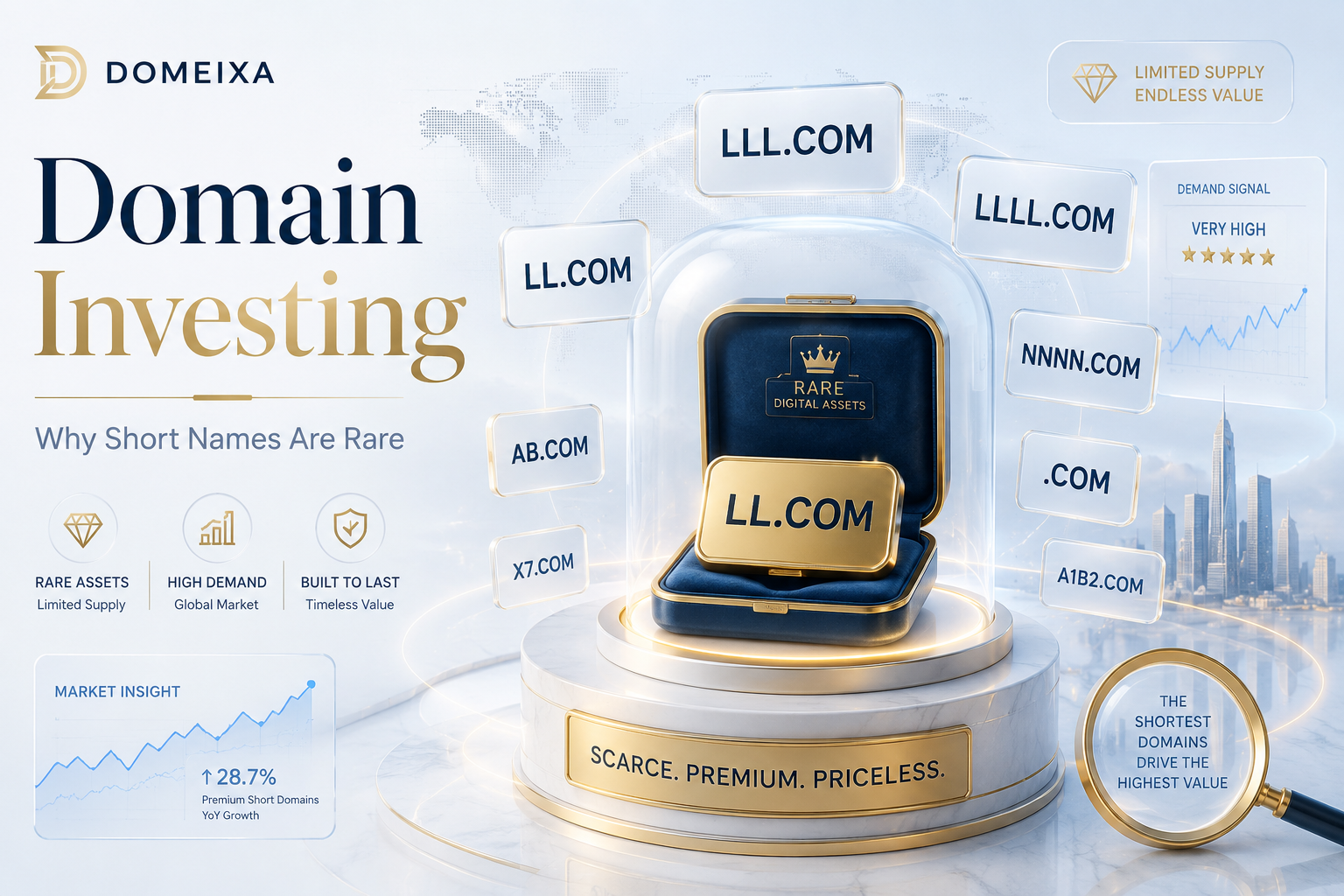
Domain Investing: Why Short Names Are Rare
A comprehensive analysis of the global .COM aftermarket, four-letter domains, letter-and-number combinations, numeric names, hyphenated domains, liquidity, scarcity and the factors that determine real commercial value.
Core Principle
Short domains are scarce because their theoretical supply is permanently limited, but scarcity alone does not guarantee value.
Quick answer: why are short domains valuable?
Short domain names combine limited supply with practical business advantages. They are easier to remember, type, pronounce, display in a logo, use in email addresses and communicate across international markets. The strongest examples also carry semantic meaning, recognizable initials, balanced letter patterns or category-defining words. However, a short name made from random or awkward characters may remain far less valuable than a longer domain with clear commercial meaning.
How large is the global domain market?
The domain industry consists of several different markets that should not be confused. The first is the registration market, where registries and registrars sell new registrations and renewals. The second is the aftermarket, where already registered domains are sold between owners, investors, companies and brokers. The third includes developed websites, businesses and digital assets whose value extends beyond the domain itself.
According to Verisign’s Domain Name Industry Brief, the world ended the fourth quarter of 2025 with approximately 386.9 million registered domain names across all top-level domains. The .COM namespace alone contained approximately 161 million registrations, confirming that .COM remains the largest single commercial domain extension. :contentReference[oaicite:1]{index=1}
The true worldwide value of secondary-market domain sales cannot be measured precisely. Many transactions are private, subject to confidentiality agreements, completed through brokers, marketplaces, registrars, law firms or direct company acquisitions. Published databases therefore represent only the visible portion of the market.
Verified Transaction Data
At least hundreds of millions of dollars move through the premium domain aftermarket every year
Escrow.com reported more than USD 395 million in domain transactions facilitated through its platform during 2025, representing year-over-year growth of 5.6%. The fourth quarter alone accounted for approximately USD 102.5 million. :contentReference[oaicite:2]{index=2}
This figure is not the size of the entire global market. It represents verified volume from one major escrow provider and excludes many registrar marketplaces, private transactions, confidential corporate acquisitions, lease-to-own agreements and deals completed through other payment channels.
What can be stated responsibly?
- The global aftermarket is substantial.
- .COM remains the dominant premium extension.
- Private sales make exact totals impossible.
- Public databases show only part of the market.
- Reported turnover is not the same as investor profit.
Why .COM remains the benchmark
.COM is not automatically the best extension for every project, but it remains the primary reference point for global commercial naming. It is familiar across countries, industries and languages, and it does not geographically restrict a company to one national market.
The size of the .COM registration base creates both strength and scarcity. With approximately 161 million .COM names registered at the end of 2025, many intuitive words, abbreviations and short combinations are already controlled by existing companies, investors or long-term holders. :contentReference[oaicite:3]{index=3}
| Extension | Primary Strength | Investor Perspective | Main Risk |
|---|---|---|---|
| .COM | Global commercial recognition | Deepest end-user market and strongest historical sales evidence | High acquisition prices and limited premium supply |
| .AI | Immediate artificial-intelligence positioning | Rapidly growing technology demand | Trend concentration and higher renewal costs |
| ccTLD | Strong national trust and local relevance | Useful when buyer demand is concentrated in one country | Smaller geographical buyer pool |
| Other gTLDs | Category-specific meaning and wider availability | Selective opportunities in strong words and combinations | Uneven adoption, liquidity and renewal pricing |
Escrow.com recorded USD 27.1 million in .AI transactions during 2025, almost triple the 2024 figure. Even with that growth, .AI represented only 6.9% of Escrow.com’s reported annual domain volume, while .COM remained the dominant extension for larger premium transactions. :contentReference[oaicite:4]{index=4}
The mathematics of scarcity: how many short domains can exist?
The scarcity of short domains is not merely a marketing claim. It can be demonstrated mathematically. If a domain uses only the 26 basic Latin letters, the number of possible combinations is permanently fixed.
| Domain Pattern | Theoretical Supply | Calculation | Typical Market Interpretation |
|---|---|---|---|
| LL.COM | 676 | 26² | Ultra-scarce corporate initials and global brands |
| LLL.COM | 17,576 | 26³ | Acronyms, abbreviations and highly liquid premium inventory |
| LLLL.COM | 456,976 | 26⁴ | Brandable names, acronyms, pronounceable patterns and investor liquidity |
| NNNN.COM | 10,000 | 10⁴ | Numeric brands, dates, cultural number patterns and speculative demand |
| Four-character alphanumeric | 1,679,616 | 36⁴ | Letters and digits combined, with widely differing quality |
Theoretical scarcity is only the starting point. Commercial scarcity is much narrower. Of 456,976 possible four-letter combinations, only a fraction are pronounceable, meaningful, visually balanced, acronym-rich or suitable for a global brand.
Four-letter .COM domains: one category, many quality levels
Four-letter .COM domains are frequently treated as a single asset class, but their quality differs dramatically. A pronounceable name such as a compact CVCV pattern can function as a global startup brand. A strong acronym may attract corporations, investment funds or technology companies. A random sequence with difficult pronunciation may have value mainly as scarce inventory.
Pronounceable
Easy vowel-consonant patterns can operate as independent global brands.
Acronym-rich
Multiple possible corporate meanings can expand the buyer pool.
Dictionary word
Rare four-letter words combine extreme brevity with immediate meaning.
Random letters
Scarce by length, but potentially weak in pronunciation and end-user demand.
Escrow.com reported that the median price of four-letter .COM domains in its Q4 2025 transaction sample increased by 21.2% to approximately USD 10,000. This is useful market evidence, but it should not be interpreted as a universal valuation for every four-letter domain. Quality, pattern, letters, buyer motivation and transaction sample size remain decisive. :contentReference[oaicite:5]{index=5}
Two-letter and three-letter .COM domains
Two-letter and three-letter .COM domains belong to a much smaller and more mature premium market. Their limited supply makes them attractive for corporate initials, international abbreviations, rebrands and holding-company identities.
Escrow.com’s 2025 data illustrates both their high price level and their volatility. Two-letter .COM sales returned to the market in the second quarter with a reported median of USD 775,000. Three-letter .COM medians reached USD 120,000 in the third quarter before falling to USD 47,000 in the fourth quarter, showing how a limited number of exceptional transactions can materially affect quarterly statistics. :contentReference[oaicite:6]{index=6}
Myth versus reality
Every three-letter or four-letter .COM is valuable
Not necessarily. Shortness creates scarcity, but value also requires demand. Letter quality, pronunciation, acronym potential, cultural meaning, previous use, legal risk and the number of realistic end users can create enormous differences between domains of identical length.
An investor should therefore distinguish between scarcity value, wholesale liquidity and end-user value. These are related, but they are not identical.
Short domains with numbers: when do they work?
Numbers can strengthen or weaken a domain depending on context. They may represent a year, product generation, quantity, cultural symbol, financial concept, sports format, scientific notation or memorable brand element. They can also create confusion when users do not know whether the number should be typed as a digit or written as a word.
| Pattern | Example Structure | Potential Strength | Typical Risk |
|---|---|---|---|
| LNN.COM | A24.com | Very short, suitable for media, services or product systems | Meaning may be unclear without marketing |
| LLN.COM | AI7.com | Can combine a category acronym with a memorable digit | May resemble a model number rather than a company |
| NNNN.COM | 2025.com | Language-neutral and culturally meaningful in some markets | Demand can depend heavily on number symbolism |
| Word + number | Studio360.com | The number can reinforce completeness or product positioning | Longer and more difficult to dictate |
Escrow.com reported that four-number .COM domains reached a median transaction price of USD 92,500 in its Q2 2025 sample. This does not mean that every NNNN.COM domain is worth that amount; numeric quality, repeated digits, sequences, cultural preferences and limited transaction counts can strongly influence the median. :contentReference[oaicite:7]{index=7}
What are hyphenated domains?
A hyphenated domain separates two or more terms with the character “-”, for example smart-cloud.com. Standard ASCII domain labels may contain letters, digits and hyphens, but a label cannot begin or end with a hyphen. Individual DNS labels are limited to 63 octets. :contentReference[oaicite:8]{index=8}
Hyphens are technically valid and can improve the readability of two-word phrases. In some European markets, hyphenated domains are relatively familiar. They may also be useful when the non-hyphenated version is unavailable or when a phrase needs a clear visual separator.
Potential advantages
- clear separation of two words,
- greater availability,
- possible relevance for local-language phrases,
- lower acquisition cost,
- useful defensive registration.
Potential disadvantages
- harder to communicate verbally,
- users may omit the hyphen,
- email addresses become less elegant,
- weaker global brand appearance,
- traffic may leak to the non-hyphenated version.
For a global brand, the non-hyphenated version is usually preferable when it is available and legally safe. A hyphenated domain can still be commercially useful when the wording is strong, the target market accepts hyphens or the domain serves as a campaign, descriptive portal or defensive asset.
What determines the value of a short domain?
Length and supply
Shorter categories have a permanently smaller theoretical inventory, but length must be combined with usable quality.
Meaning and commercial intent
Words connected with finance, health, software, travel, energy or other high-value sectors may attract larger buyer pools.
Pronunciation and radio test
A listener should ideally be able to hear the name once and type it correctly without explanation.
Extension
The same string can have radically different liquidity and end-user value across .COM, a national ccTLD and a newer extension.
Comparable sales and liquidity
Comparable transactions help define a range, but unique domains rarely have a perfect equivalent.
Legal and historical risk
Trademark conflicts, spam history, malware, abusive backlinks or ownership disputes can materially reduce value.
Investment Reality
A domain is not a liquid security
Premium domains can preserve or increase value, but they do not trade like publicly listed shares. A sale may require months or years, and the final price depends on finding a buyer whose commercial need matches the asset.
Investors must account for renewal costs, marketplace commissions, escrow fees, negotiation time, currency risk, legal review and the possibility that a domain may never sell at the expected price.
Wholesale value, retail value and strategic value
| Value Level | Typical Buyer | Transaction Context | Expected Pricing Logic |
|---|---|---|---|
| Wholesale | Domain investor | Fast resale, auction or portfolio trade | Lower price reflecting holding risk and resale margin |
| Retail | Startup, company or project owner | The domain matches a real branding requirement | Higher price based on end-user utility |
| Strategic | Large company, category leader or rebranding buyer | The domain reduces confusion, acquisition cost or competitive risk | Potentially substantial premium over ordinary retail value |
This explains why automated appraisals and comparable sales can never determine one universally correct price. The same domain may be worth a modest amount in a wholesale auction and a much higher amount to a company for which it is the exact strategic identity.
Due diligence before buying a domain
Before acquiring a domain as an investment or operational asset, verify more than the name itself.
- current ownership and transfer eligibility,
- historical website content,
- search-engine indexation,
- backlink quality and anchor texts,
- spam, phishing or malware history,
- renewal pricing and registrar conditions.
- registered and pending trademarks,
- similar company names and domains,
- social-handle availability,
- pronunciation in target languages,
- email and visual-brand usability,
- secure escrow and transfer procedure.
Important: purchasing a domain does not automatically grant trademark rights. Legal clearance should be completed separately in every relevant jurisdiction and business category.
How DOMEIXA evaluates short digital identities
DOMEIXA does not evaluate domains only by character count. The curation process considers memorability, phonetic structure, visual balance, international usability, possible industries, commercial expansion, search relevance, legal distinctiveness and the ability of a name to support a real company.
The Aurum Domains collection presents adaptable global identities with strong brand potential. The Platinum Domains category is reserved for exceptional assets and domain ecosystems with broader strategic positioning. Technology-focused founders can also explore curated identities for AI startups and biotechnology and gene innovation.
Each selected domain can be presented through a Digital Asset Memorandum explaining potential positioning, brand architecture, market applications, SEO opportunities, visual direction and the secure acquisition process.
Domain investment checklist
- Is the domain easy to pronounce and type?
- Does it pass the radio test?
- Is the extension appropriate for the target market?
- Is the name commercially meaningful?
- How many realistic end users exist?
- Are comparable sales truly comparable?
- What are the annual holding costs?
- Is the history clean and relevant?
- Are there trademark or naming conflicts?
- Is the expected holding period realistic?
- What is the likely wholesale exit price?
- Can the asset support an operating business?
Scarcity Is Only the Beginning
The strongest short domain is not merely rare. It is useful, memorable and commercially credible
Short domains occupy a unique position between digital infrastructure, branding and investment. Their supply is finite, but their value depends on language, extension, market demand, legal safety and the future company that can be built around them.
Explore the DOMEIXA portfolio and discover curated digital identities designed for global companies before they exist.
Frequently asked questions about short-domain investing
1. Are all short domains valuable?
No. Length creates scarcity, but value also depends on meaning, pronunciation, extension, buyer demand, legal safety and commercial usability.
2. Why are four-letter .COM domains popular?
They are short enough for branding and email use while offering more combinations than two- or three-letter domains. Pronounceable and acronym-rich examples can attract both investors and end users.
3. How many four-letter combinations exist?
There are 456,976 possible four-letter combinations using the 26 basic Latin letters. Only a smaller proportion are highly pronounceable, meaningful or commercially attractive.
4. Is .COM still the strongest investment extension?
.COM remains the primary global commercial benchmark and has the deepest historical aftermarket. Other extensions can be valuable, but demand and liquidity vary significantly.
5. Are numeric domains valuable?
Some are. Repeated digits, memorable sequences, years and culturally significant numbers can attract strong demand. Random numeric combinations may have much lower value.
6. Do numbers make a brand weaker?
Not automatically. Numbers can strengthen a name when they carry an obvious meaning, but they can create spelling ambiguity or make the brand feel like a product model.
7. Is a hyphenated domain bad for SEO?
A hyphen is not a technical SEO penalty. The main disadvantages concern memorability, verbal communication, email usability and possible traffic leakage to the non-hyphenated version.
8. How large is the global domain aftermarket?
No complete global figure exists because many sales are private. Escrow.com alone facilitated more than USD 395 million in domain transactions during 2025, while other marketplaces and direct deals add further unreported volume.
9. How quickly can a domain be sold?
There is no guaranteed timeline. Highly liquid categories may sell quickly at wholesale prices, while an end-user sale can require months or years.
10. Are automated domain appraisals reliable?
They can provide a rough reference, but they cannot fully assess strategic buyer fit, legal context, pronunciation, brand potential or negotiation conditions.
11. Does buying a domain give the buyer trademark rights?
No. Domain ownership and trademark rights are separate. A legal search should be completed before launching a brand or acquiring a potentially conflicting name.
12. Is domain investing guaranteed to be profitable?
No. Domains are illiquid and speculative assets. Profit depends on acquisition discipline, holding costs, market demand, legal safety and the ability to reach suitable buyers.
Research basis and methodology
Market figures in this article distinguish between total domain registrations and reported aftermarket transactions. Registration statistics are based on the Verisign Domain Name Industry Brief. Aftermarket figures are based primarily on verified Escrow.com transaction data. Because a substantial proportion of domain sales remains private, no published source can provide a complete worldwide aftermarket total.
This article is intended for educational and strategic purposes and does not constitute financial, investment, tax or legal advice.